

France: Around 1.6 Million Protesters in Broad Movement Bringing Together Workers and Students Demanding Higher Wages and Better Services
Hundreds of thousands of workers, employees, and high school students took to the streets across France on Thursday in what was described as the largest mobilization this autumn, demanding wage increases and improved public services.

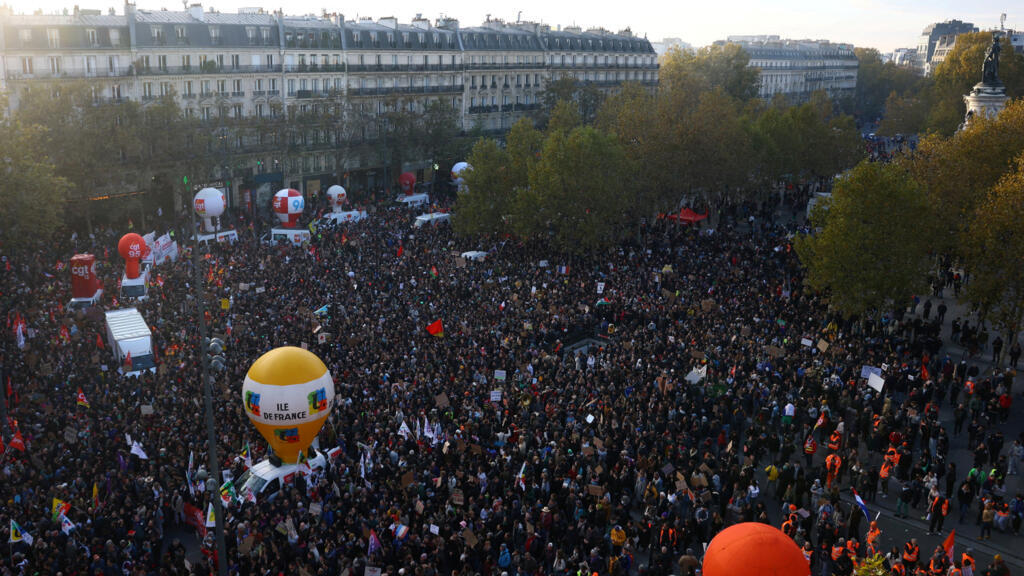
- Between 600,000 (according to the Interior Ministry) and 1.6 million demonstrators (according to trade unions) took part in the largest mobilization seen this autumn.
- A striking convergence between students and unions across education, healthcare, and automotive sectors to denounce low salaries and deteriorating study and working conditions.
- A security mobilization of about 70,000 personnel and reported skirmishes in Paris, amid anticipation of an upcoming social conference at the Matignon.
French cities witnessed a broad social mobilization on Thursday, described as the largest since the beginning of this autumn, as hundreds of thousands of workers, employees, and high school students took part in joint marches demanding wage increases, improvements in public services, and better living and educational conditions.
The General Confederation of Labour (CGT) reported that participant numbers approached 1.6 million people across France, including 350,000 in the capital, Paris. Meanwhile, the Ministry of the Interior estimated the turnout at about 600,000 protesters, according to a provisional tally announced in the afternoon.
A Broad Coalition and Demands Affecting Daily Life
The protests kicked off in response to a unified call issued by five major trade unions (CFDT, CGT, FO, FSU, and Unsa), encompassing public and private sector employees alongside the student movement. Demands were no longer confined to study conditions and reforms to the university admissions platform "Parcoursup"; they expanded to include raising the minimum wage (SMIC), ensuring tax justice, and supporting public services, in addition to protesting police violence and restrictions on demonstrations.
A notable presence in the demonstrations was that of workers in low-income professions that directly affect families' daily lives, such as accompanying personnel for students with disabilities (AESH). Maryam Touré, who alongside her colleagues earns roughly 1,030 euros net per month, explained that low salaries hamper recruitment and deprive children of adequate care, reiterating their demand to transition into stable, Category B civil servant status.
Struggles in Schools and Private Sector Pressures
High school students in the Paris suburbs, particularly Montreuil and Romainville, voiced complaints regarding the lack of resources in educational institutions, from the absence of heating to long distances that force some to spend two hours a day on public transit. In the healthcare sector, nursing staff from Pitié-Salpêtrière Hospital expressed their dissatisfaction with the worsening shortage of medical staff and resources required to care for patients.
Private sector workers were also visibly present; workers from the Stellantis factory in Poissy participated to demand an increase of 450 euros per month, stressing that the rising cost of living deprives the working classes, who produce the wealth, of living with dignity, as they put it.
Security Measures and an Anticipated Government Conference
On the ground, authorities mobilized 70,000 police and gendarmerie officers across France to secure the marches. In Paris, shops along Boulevard Voltaire were forced to shutter their doors to prevent damage, along a route that witnessed the deployment of tear gas canisters and the use of batons, as street medic teams intervened to treat injuries sustained by protesters.
Facing this pressure on the ground, Prime Minister Sébastien Lecornu announced the organization of a "social conference" on Monday at the prime minister's office (Matignon), bringing together trade unions and employers' organizations to discuss the current situation, at a time when protesters believe the current phase requires sustained pressure to achieve tangible results.
Source: RFI
Comments (0)
You must log in to comment on articles.
Log in Sign upBe the first to comment on this article.