

Case of the 'Martyr of the A10': French Judiciary Unearths the Tragedy of Inès Touloub Amid Mystery Veiling Her Short Life
Inside the Blois Assize Court, the trial of the parents of Inès Touloub, known for decades as the 'Martyr of the A10', reveals the horrifying torture she endured, contrasting with the complete obscurity that shrouded her brief four-year life.

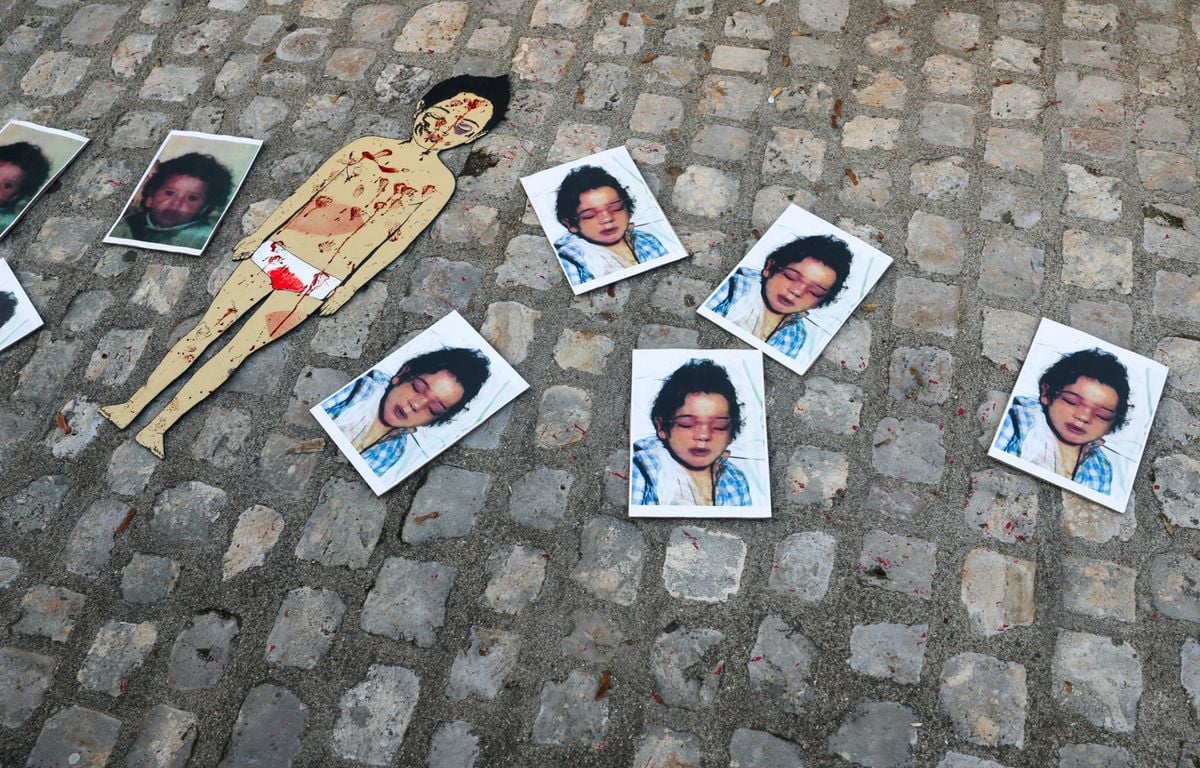
- The Blois Assize Court hears forensic reports documenting horrifying signs of torture on the body of four-year-old Inès Touloub.
- The family lived in total isolation within a 20-square-meter dwelling in Puteaux, amid a complete absence of neighbor testimonies or school monitoring.
- Administrative loopholes allowed the child's disappearance to go unnoticed for decades; her name was removed from her mother's passport in 1992 and struck from Family Allowance Fund (CAF) records in 1997 without any investigation.
Inside the courtroom of the Assize Court in Blois (Loir-et-Cher), a single, faded photograph with yellowed edges was projected on the screen. It showed one-year-old Inès Touloub sitting beside her maternal grandmother, with curly brown hair and wide, dark eyes. This photograph is the only glimpse of Inès alive, discovered by investigators with her mother, Halima El Bakhti, who is on trial for "acts of torture and barbarity resulting in unintentional death," alongside her husband, Ahmed Touloub, who is being prosecuted for "complicity."
The Mystery of a Child Known Only by Her Wounds
It took gendarmes nearly thirty years to put a name to the mutilated little body found on the side of the A10 motorway in August 1987, known in the media at the time as the "Martyr of the A10." However, restoring her identity did not dispel the mystery surrounding her life and personality. Since the beginning of the trial, expert testimonies followed one after another, and about 15 autopsy photographs were examined. Consequently, what has been documented about her death and torture far exceeds what is known about the four years of her life; to date, no details have emerged regarding whether she was a cheerful or quiet child, or what her relationship was like with her siblings.
Available records indicate that Inès was born in Morocco in July 1983 and spent her first year there under her grandmother's care before moving to live with her parents in France in late 1984 or early 1985. The family initially lived in Vitry-sur-Seine (Val-de-Marne) before relocating to Puteaux (Hauts-de-Seine), where a family of eight (the parents and six children) was crammed into a dwelling measuring no more than 20 square meters behind the grocery store managed by the father.
Total Isolation and Complete Absence of Social Oversight
With 39 years having passed since the events, the investigation faced immense challenges due to the death of doctors, damaged documents, and the disappearance of witnesses. Retired Gendarmerie Major Benoît Paris, who led the investigation, confirmed in response to questions from lawyer Frank Berton, defense counsel for the father, that none of the family's neighbors in Puteaux had provided any testimony. He explained that the upstairs neighbor had passed away, and no one had ever contacted the investigative team.
Although Inès's two older sisters were enrolled in school, and Inès was scheduled to start nursery school just two weeks after the date of her death, investigators found no trace of teachers or authorities who had interacted with her. The only social inquiry had been conducted in 1985 as part of an application to regularize their residency status. In a striking administrative irony, the child's name was removed from her mother's passport in 1992, and the Family Allowance Fund (CAF) was notified in 1997 that she was no longer part of the household—a full ten years after her death—without the matter raising any suspicion, even though she would have been 14 years old at the time.
Excruciating Pain and a Cloak of Family Silence
Forensic reports showed that the child suffered excruciating pain. Doctors pointed to an untreated fracture in her left forearm that caused the limb to be shortened by several centimeters. Medical expert Pauline Saint-Martin commented on the mother's statements regarding the child crying, refusing to eat, and vomiting, noting that these symptoms likely represented a physiological reaction to the intensity of the pain.
In the courtroom, the parents remained silent and claimed memory loss regarding most of the events, merely admitting briefly that the child found wrapped in the blue blanket was their daughter. The court is expected to hear testimony from one of Inès's sisters via video conference behind closed doors, in another sign of the heavy family secret that erased the victim's life and turned her into an enigma that even the justice system has struggled to fully unravel.
Source: 20 Minutes


Comments (0)
You must log in to comment on articles.
Log in Sign upBe the first to comment on this article.