

How to Obtain Stateless Person Status ("Apatride") in France: Full Details
A detailed legal guide outlining the complete procedures, conditions, and steps required to apply for stateless person status (apatride) through France's OFPRA.

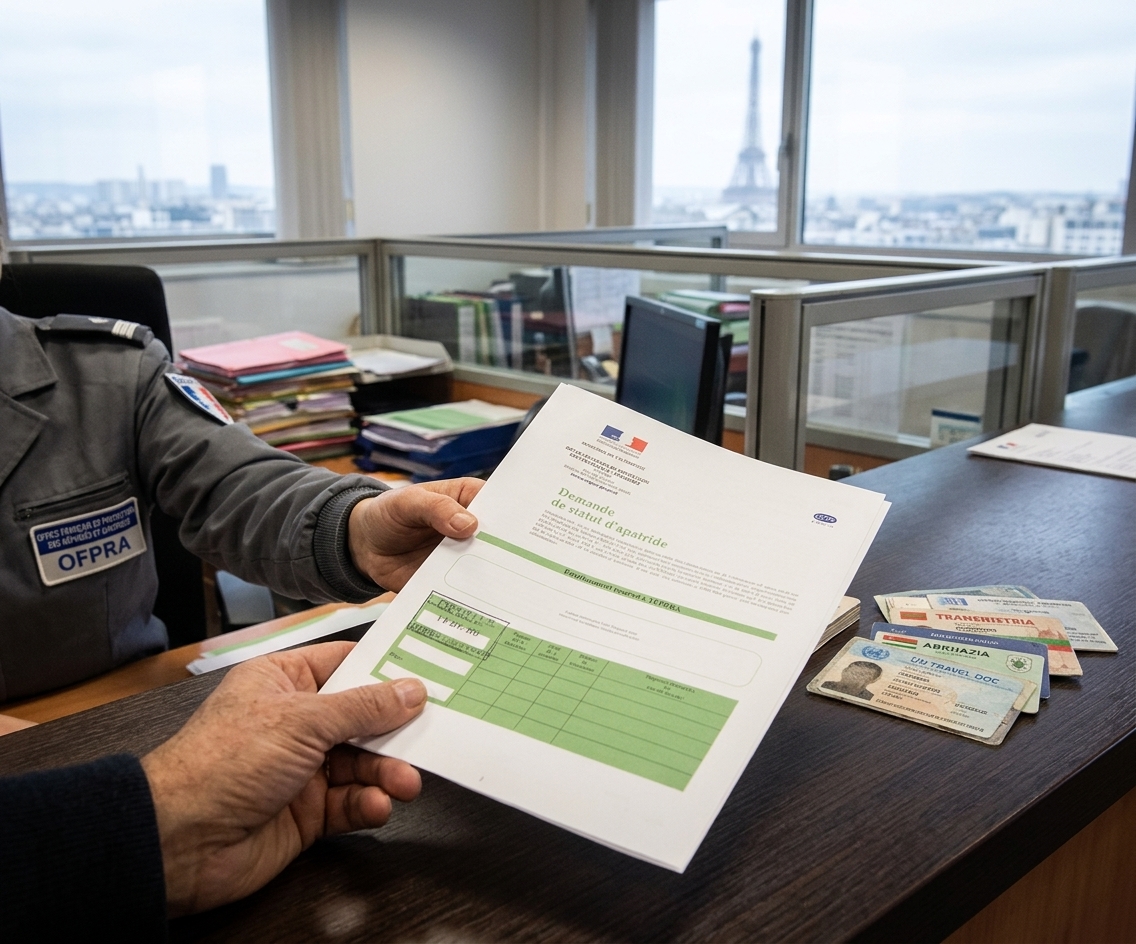
- A stateless person (apatride) is defined under the 1954 New York Convention as someone not recognized as a national by any state under its domestic laws.
- Applications are processed exclusively through the French Office for the Protection of Refugees and Stateless Persons (OFPRA) based on legal nationality ties rather than fear of persecution.
- The application process requires submitting a formal request letter, completing the specialized green application form, obtaining a registration receipt, and attending a comprehensive interview.
- Recognized stateless individuals receive a multi-year residence permit valid up to four years, full employment rights, access to a 10-year card thereafter, and family reunification benefits.
*- Who is a stateless person?:
The term "Apatride / Stateless Person" refers to an individual who does not hold any nationality. This designation applies to people who possess no documents proving their citizenship, or whose nationality is not recognized by any sovereign state.
According to the New York Convention of September 28, 1954, the term stateless person applies to:
"any person who is not considered as a national by any State under the operation of its law."
In France, the government grants the right of residence to individuals recognized as stateless (apatrides), providing them with necessary legal protection and social support.
The French Office for the Protection of Refugees and Stateless Persons (Ofpra) is tasked with recognizing the status of stateless persons who request it in France and providing them with legal and administrative protection, in accordance with the provisions of the Code on Entry and Residence of Foreigners and the Right of Asylum (Ceseda). Statelessness can result from several circumstances:
- Conflicts between different nationality laws,
- State succession and transfers of sovereignty,
- Failure or absence of birth registration laws,
- Strict enforcement of jus soli (right of the soil) and jus sanguinis (right of blood),
- Deprivation or loss of nationality without the possibility of recovering it.
- Stateless status ceases once an individual acquires a nationality or regains their nationality of origin.
*- Note: An application for stateless status does not take into account the fear of persecution—unlike an asylum request—but is strictly based on the absence of any legal nationality bond between the individual and a state.
Should an individual declare statelessness alongside a fear of persecution if returned to their country of habitual residence, their application will be examined by Ofpra as a priority under the Geneva Convention. If the decision is favorable, the applicant will receive "stateless refugee" status and the protection framework granted to recognized refugees.
*- How to apply for stateless status ("Apatride")?:
Articles L.582-1 et seq. of the Code on Entry and Residence of Foreigners and the Right of Asylum (Ceseda) outline the procedures for requesting stateless status. A foreign national wishing to apply must contact Ofpra directly by standard postal mail to request the application form. The process proceeds through the following phases and steps:
01 - Step One: The Request Letter (The Story).
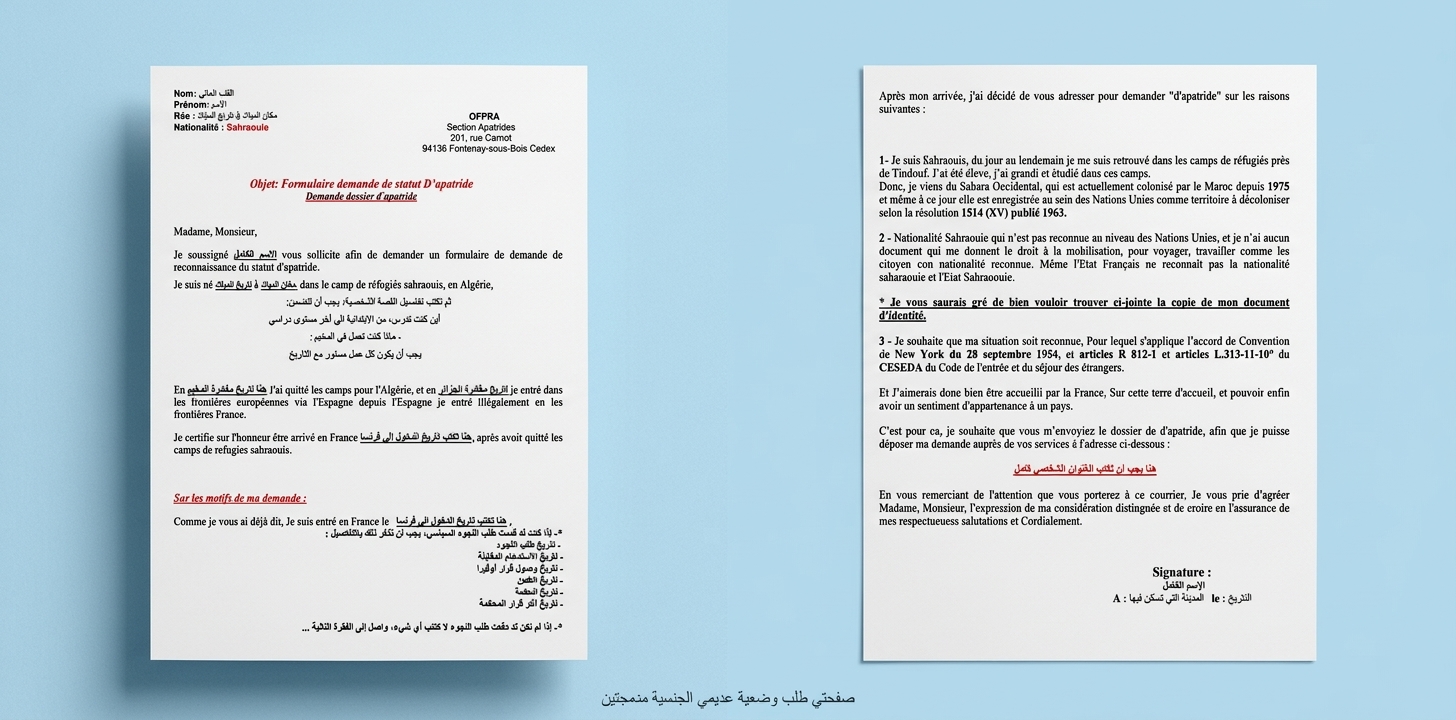
To obtain an application file for stateless status, the applicant must draft a formal letter in French detailing their personal narrative, which differs fundamentally from an asylum narrative. The letter must state the applicant's surname, first name, and postal address (a certificate of residence is not strictly required; a stable mailing address to receive administrative correspondence is sufficient). It must also include civil status information, educational and professional background, precise dates and travel routes from the time of departure from the country of origin up to arrival in France, and the specific legal reasons justifying the claim of statelessness. This letter must then be mailed along with a copy of an identity document to Ofpra via registered mail with acknowledgment of receipt:
(lettre recommandée avec avis de réception - AR)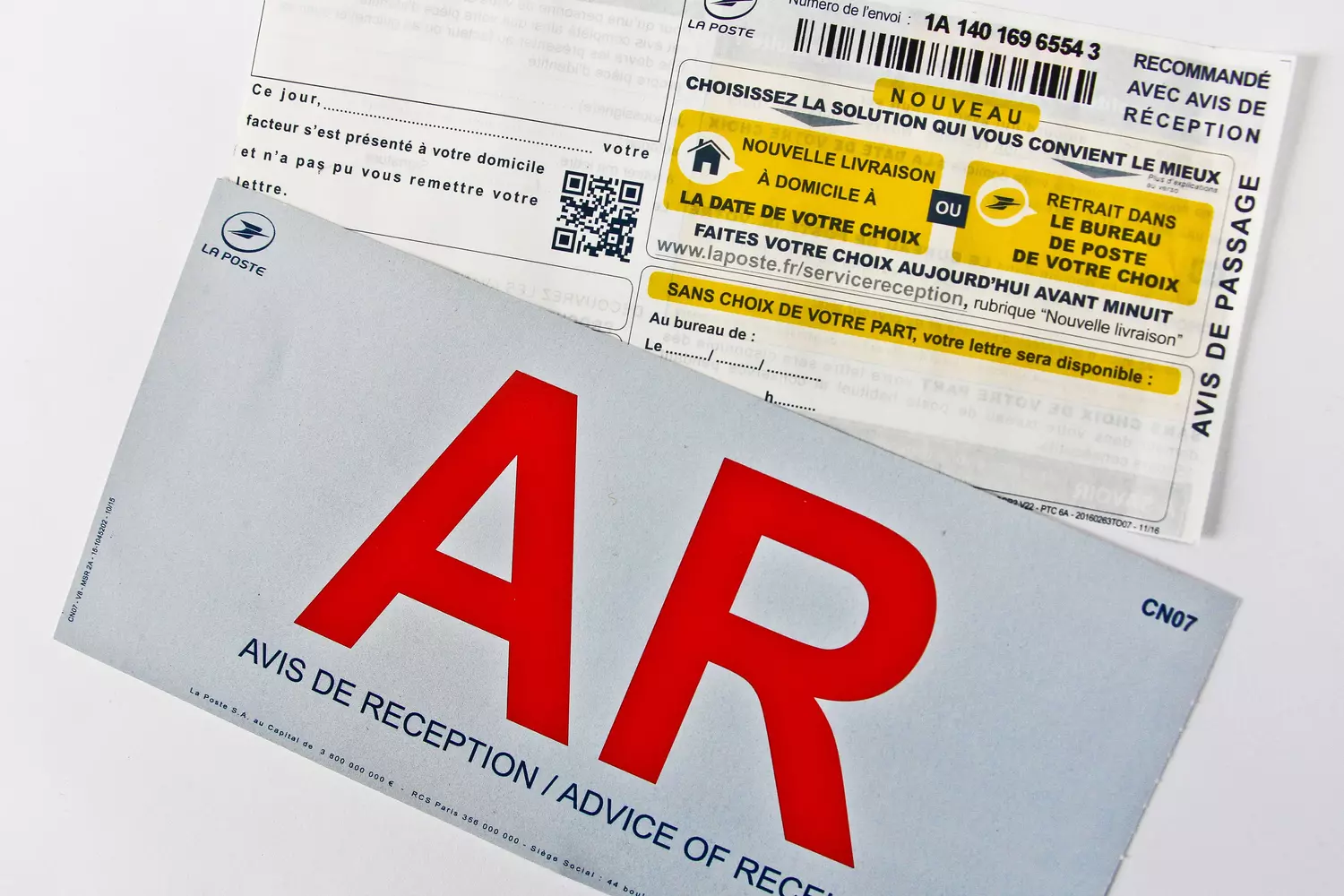 (See attached template for an applicant originating from Western Sahara / Sahrawi refugee camps).
02 - Step Two: The Application File (Stateless Application Form).
A few days after dispatching the letter to Ofpra, you will receive an acknowledgment of receipt. Approximately two weeks or more later, an application package for the recognition of stateless status will be delivered to the address provided. The form provided by the office must be completed entirely in French. It resembles an asylum application form in structure and layout, with the primary difference being that asylum forms are blue, whereas stateless forms are green.
For further details on how to complete the application file, refer to the following article:
Asylum Application File in France: How to Complete It and What Information Is Required?
The application must be accompanied by two passport-sized photographs, dated and signed, and, where available, copies of travel documents, national identity cards, and civil status records such as:
Birth certificate, nationality certificate, marriage certificate, proof of paternity or filiation, and census certificates for the applicant and their parents (such as the Spanish census documents for Sahrawis registered by the UN mission MINURSO, or UNRWA registration documents for Palestinians), among others.
Note: Original documents should not be sent by mail; copies are sufficient, while original records should be presented during the in-person interview generally held at Ofpra headquarters in Paris.
- The completed file along with the supporting documents should then be mailed back to Ofpra, preferably via registered mail with acknowledgment of receipt.
03 - Step Three: The Registration Receipt.
Once an application is submitted fully completed without missing components, the Ofpra stateless persons secretariat registers the file and promptly issues a formal registration letter sent by regular postal mail to the applicant's address.
This document contains the applicant's identification details and assigned file number. It serves as proof of a pending stateless application while awaiting an interview summons.
*- Because the French immigration code (Ceseda) contains no explicit statutory provision regularizing the temporary residence of applicants for stateless status during examination, prefectures are under no legal obligation to issue temporary residence permits. Under strict reading of French law, applicants do not hold an automatic right to stay pending review; however, this is rarely enforced in practice and carries no adverse retroactive consequence for the applicant. Consequently, the legal safeguards governing asylum seekers do not automatically apply to stateless status applicants.
04 - Step Four: The Interview (Investigation).
Following an initial investigation period that can vary depending on the case (ranging from 1 to 12 months), the Ofpra stateless secretariat sends a summons by postal mail to the applicant's address, requiring their personal appearance at Ofpra's offices in the Paris suburbs. The interview aims to verify the applicant's identity, evaluate their eligibility for stateless status, examine the submitted documents, and question them on their personal background and departure from their country of origin. The office typically retains the applicant's original identity and civil documents until a final determination is reached (national ID, passport, civil records, etc.).
The interview structure is similar to that of asylum hearings, with a specific focus on determining the absence of nationality. Based on the applicant's statements, Ofpra gathers and reviews information to identify any countries to which the applicant may have legal ties (country of birth, parents' country of origin, habitual residence, etc.). It examines whether the applicant can claim nationality from any of these states. Ofpra also reserves the right, in cases of doubt, to query foreign authorities to ascertain whether any legal nationality link exists that would disqualify the person from stateless status.
*- For further insight into the interview process, read the following article:
What Do You Know About the Ofpra Interview? An Interview with an Ofpra Officer
05 - Step Five: The Decision (Approval).
Following a second examination period that also ranges between 1 and 12 months, the Ofpra stateless persons division mails the decision to the applicant's registered address.
If the decision is favorable, Ofpra sends an official certificate of recognition accompanied by a guide explaining the subsequent administrative steps, including integration criteria and the procedure for securing a stateless residence card. This process is typically facilitated through authorized immigrant and asylum assistance organizations recognized by the Ministry of the Interior and regional prefectures.
Once recognized as a stateless person, the individual is placed under the legal and administrative protection of Ofpra. French civil law governs their personal status (marriage, divorce, etc.) as well as their administrative standing (residency and travel documents).
Legally recognized stateless individuals receive a multi-year temporary residence card bearing the mention "Bénéficiaire du statut d'apatride" (Beneficiary of stateless person status), valid for up to four years. This permit authorizes work across France under the same conditions as French citizens. Upon completion of four years, the holder may apply for a 10-year residence permit under Article L.424-21 of Ceseda.
*- If your application was approved and you are unsure of next steps, consult the following guide:
Refugee Guide: You Have Been Granted Status—Where Do You Begin?
Furthermore, a recognized stateless person holding a temporary or annual residence card is entitled to request family reunification under the same terms as recognized refugees (limited to direct first-degree relatives: spouse and minor children) pursuant to Article L.582-6 of Ceseda.
*- For more information on this subject, read the following article:
What Do You Know About Family Reunification in France? Procedures and Regulations.
06 - Step Six: Rejection and Legal Remedies (Appealing a Negative Decision).
In the event of a negative decision—usually issued when legal factors contradict stateless status (such as a pending or granted claim in another country, holding citizenship of a recognized state, or possessing a permanent residence card in an EU member state)—the refusal letter is delivered alongside all original documents deposited with Ofpra during the interview.
The refusal notification informs the applicant that they have two months (60 days) from the date of notification to file an appeal before the Administrative Court (Tribunal Administratif) pursuant to Article R. 312-6 of Ceseda. The applicant may subsequently appeal an unfavorable administrative court ruling before the competent Administrative Court of Appeal (Cour administrative d'appel), and ultimately lodge a cassation appeal before the Council of State (Conseil d'État).
These judicial proceedings can span several years, typically between 3 and 8 years.
Appealing a statelessness rejection before the Administrative Court does not have suspensive effect. For instance, if an applicant is issued an Obligation to Leave French Territory (OQTF), the prefecture may enforce removal even if the administrative court has not yet ruled on the appeal.
Important Notice: The National Court of Asylum (CNDA) has no jurisdiction over stateless status applications; it is exclusively competent to adjudicate asylum claims.
Applicants are strongly advised to seek the counsel of a lawyer specializing in immigration and alien law, bearing in mind that success rates following a refusal remain very low, as decisions are based on strict legal criteria.
*- Why does the application review process take so long?
Many applicants for stateless status voice concerns regarding the lengthy waiting times before being summoned for an interview or receiving a final decision. In response to an inquiry submitted by "France News", Ofpra stated:
(("This timeframe varies from one person to another depending on the study, research, and investigation schedule conducted by the Office, particularly when uncertainties arise regarding the verification of identity, the credibility of declarations, or the authenticity of submitted documents. This necessitates intensified research, case analysis, and official inquiries directed to embassies and consulates of relevant states. A final decision cannot be issued until responses are received from the authorities involved and each response is verified individually in accordance with French law, international law, and relevant bilateral agreements, ensuring a fair, objective, and transparent determination.")).
* Special report prepared by the France News editorial team.
Comments (0)
You must log in to comment on articles.
Log in Sign upBe the first to comment on this article.