

What Story Must Be Submitted for an Asylum Application in France? A Comprehensive and Detailed Guide
A detailed narrative of an applicant's background and reasons for fleeing is the cornerstone of any asylum claim in France. Here is a comprehensive breakdown of the essential elements and questions required by French asylum authorities.

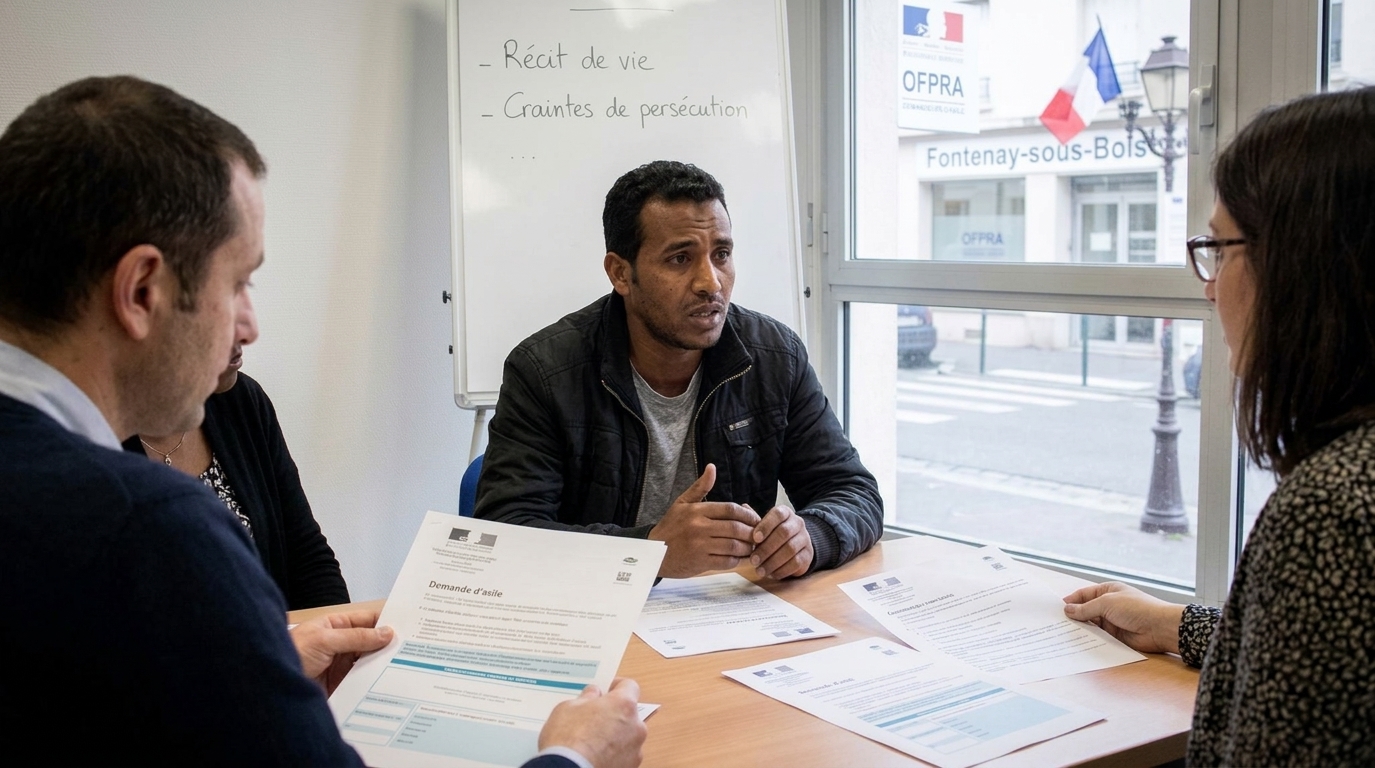
- The personal story is the most critical element of an asylum application submitted to France's Ofpra.
- Applicants must clearly define their identity, personal background, and specific persecutions suffered.
- Merely describing general conflict or chaos in one's home country is insufficient; individualized risk must be demonstrated.
- Applicants must detail their journey to France and explain why they cannot safely return or relocate within their home country.
- Supporting evidence enhances credibility, though consistency, coherence, and accuracy remain paramount.
The story submitted alongside an asylum application is the most crucial element of the file, whether the application is for political or humanitarian asylum. Therefore, it must be written precisely, clearly, and in detail to ensure a favorable response and the acceptance of the file. Below is a comprehensive guide to the contents of the narrative, the key events, and the essential questions that must be addressed:
While drafting your narrative, you must clarify the following:
01 - Who are you? And where do you come from?
02 - Why did you flee your country and seek the protection of another state?
- You must also speak about your fears in the event of returning to your country, and what serious dangers threaten your life or safety if you are deported to your country of origin.
- Describing the state of chaos and war in your country is not sufficient, as it is a general and widespread matter.
You must tell your own personal story and convince the person reviewing it that you personally were a victim of persecution, or that members of your family, relatives, or comrades in struggle were killed or assaulted, which subsequently elevates the risk against you personally.
· Note: If you do not speak French, you must find someone to translate your story into French. If you notice that the translation or drafting conditions were not optimal, you may state this within the narrative. France provides individuals who do not speak French with an oral interpreter to assist them during the interview at the French Office for the Protection of Refugees and Stateless Persons (Ofpra) and during the hearing before the National Court of Asylum (CNDA), but not for writing your narrative.
01 - Who are you? Define your identity:
Your full name, date and place of birth, nationality, which country you come from, and specifically which region, village, or urban neighborhood. Ofpra may question you on this during the interview/investigation to verify the authenticity of your account.
02 - Details of your personal story:
- Where and how was your childhood?
- Educational background, academic level, vocational training, and professional career (primary, middle, secondary, baccalaureate, university, etc.).
- Activities you carried out in your country, the origin and value of your resources—your source of livelihood (commercial shop, farm, craft profession, other occupation, etc.).
- The various places where you lived and the reasons that may have forced you to change your place of residence.
- How your personal and family situation evolved: your career progression, meeting your partner, the birth of your children, medical conditions, etc.
- Other activities: your affiliation with a political party, trade union, religious sect, association, movement, or civil organization (provide details about this group, define its significance, missions, objectives, characteristics, etc.).
- How you joined and entered the party, movement, or union.
- What your role was exactly, and what level of responsibility you held (an ordinary member or an active and influential member).
- Your participation in and organization of demonstrations, public meetings, collective actions, social movements, anti-colonial or popular resistance movements, etc. (What specific activities did you perform, with whom, how and where, and how many times?).
Depending on the nature of your story—political or humanitarian—you must explain whether you were a victim of racial discrimination or persecution stemming from these activities, from your sexual orientation, from belonging to a persecuted ethnic minority, or from your opposition to a forced marriage imposed by your family, etc.
- Warning: If you were involved with an armed group and committed crimes, the French state may deny you refugee status.
03 - What pivotal events caused you to leave your country of origin:
- If you received threats, you must answer the following: From whom? When? Where? And how?
- If your country's authorities banned you from practicing professional or non-professional activities, you must explain and clarify this.
- If you were a victim of extortion, confiscation of property, seizure of funds, robbery under threat, or other forms of pressure.
- If you were a victim of physical assaults, property destruction, or eviction from your residence, detail this within your narrative.
- If you were subjected to arrests, abusive interrogation, beatings, torture, rape, insults, and verbal abuse (mention these events with dates, circumstances, and the perpetrators of the violence you suffered).
- If a sentence was issued against you, you were convicted, or you were imprisoned (include this in your narrative, stating dates, locations, precise descriptions of these places, and the involved actors).
- If your parents, a family member, friends, colleagues, or other members of your affiliated group were killed.
- If you were subjected to forced displacement or exile.
- If you were subjected to an intentional murder attempt, or if acts of genocide were perpetrated against your community.
*- Important: Recount these events as accurately and clearly as possible, indicating who the perpetrators of the violence and persecution were, how they acted, what measures you took to defend yourself, and what assistance you received.
- What administrative steps and procedures did you undertake to request protection from the authorities in your country (filing a complaint, referring the matter to the judiciary, sending formal letters, or visiting administrative officials)?
- What were the outcomes of the steps you took?
*- Note: In the event of physical and/or psychological sequelae and scars, it is essential to submit a medical certificate, even if recently issued.
04 - What route did you take to reach France:
When recounting your journey from leaving your homeland until your arrival in France, you should focus on the following:
- When precisely did you decide to depart and leave your country?
- How did you organize your journey (raising funds, obtaining help and assistance, contacting a smuggler, etc.)?
- How and why did you choose France to apply for asylum?
- The travel route must be specific and detailed, citing dates for the various stages, the means of transportation used, and financial costs.
05 - What would happen to you if you returned to your country today?:
Answering this question is one of the most critical factors determining your fate and the outcome of your application, as Ofpra's decision takes into account the well-founded fears presented in the event of return to your country of origin. Therefore, you must answer the following questions:
- What changes have occurred in your country since your departure? (The most significant changes related to the reasons for your departure).
- Could your suffering from persecution recur? And could the threats you received realistically be carried out against you?
- Would you face the same fate as family members or relatives who were tortured or killed as a result of the situation described in the narrative or after your departure?
- Why can you not feel safe in another village or city in your country of origin?
06 - The importance of supporting evidence for the narrative:
In many cases, you are not strictly required to present evidence or documentation to support every element of the story; what matters most is that your statements within the narrative are precise, logical, coherent, free of contradictions in details or dates, and possess the credibility needed to convince the officer at the French Office for the Protection of Refugees and Stateless Persons (Ofpra).
Nonetheless, to substantiate the information provided in your story, do not hesitate to submit documents and photographs that reinforce your credibility (certificates, administrative records, professional cards, press articles, medical reports, etc.).
Warning: Do not attach original documents to your application file (photocopies are sufficient). However, you must present the originals during the interview.
Comments (0)
You must log in to comment on articles.
Log in Sign upBe the first to comment on this article.