

Training AI: An Environmental Cost Escalating with Every New Model
Recent reports reveal the staggering environmental toll of artificial intelligence, as training and operating advanced models consume electricity equivalent to entire cities and require millions of liters of water for cooling.

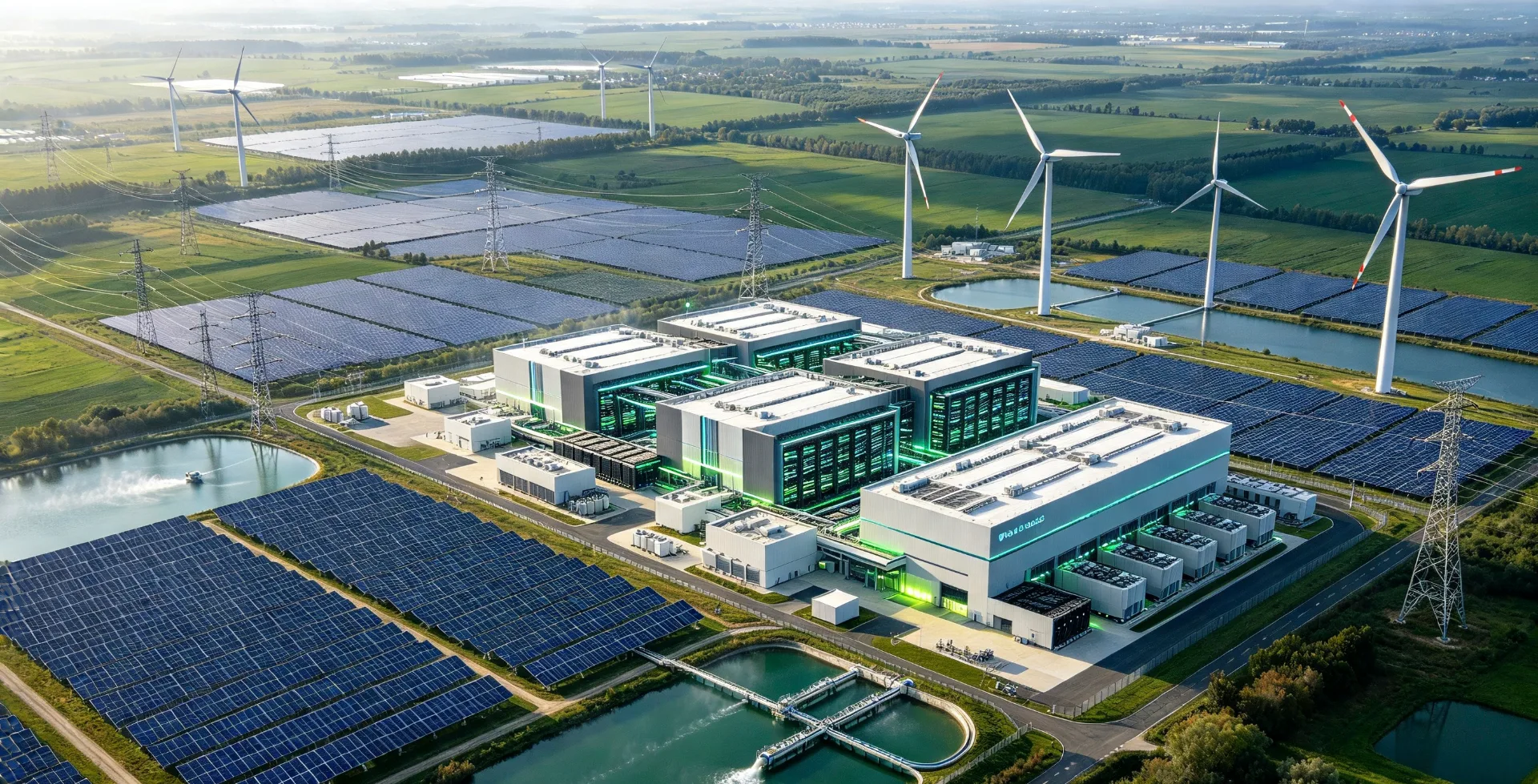
- Training AI models requires vast, escalating amounts of electricity that could soon rival the consumption of entire major cities.
- Data centers consume millions of liters of water daily for cooling, with their environmental footprint projected to worsen dramatically by 2030.
- Daily operational use (inference) accounts for 80% to 90% of total long-term AI energy consumption.
- AI's rapid expansion is driving up carbon emissions, as roughly 30% of data center electricity still relies on coal, prompting calls for regulatory and sustainable solutions.
Energy Consumption: From Megawatts to Gigawatts, with Upcoming Models Consuming the Power of Entire Cities
Recent reports published by the French newspaper "Le Monde" and various international bodies reveal that training advanced artificial intelligence models consumes electrical power measured in entire power plants, surpassing the consumption of whole cities. While training the "GPT-3" model required roughly 1,287 megawatt-hours, this figure surged with the next generation, "GPT-4," to between 50 and 70 gigawatt-hours—equivalent to the annual consumption of 15,000 American homes. Experts believe upcoming models could require continuous electrical capacity ranging from 4 to 16 gigawatts for a single training run by 2030, an amount equal to the total power consumption of New York City during the summer season.
A Heavy Water Footprint: Millions of Liters Daily to Cool Digital Centers
The impact is not limited to electricity alone; these facilities consume vast volumes of water essential for cooling, with an average data center using approximately 1.4 million liters of water daily. A report issued by the United Nations University warns that AI data center electricity consumption could reach 945 terawatt-hours by 2030—nearly three times the combined consumption of Pakistan, Bangladesh, and Nigeria—while its water footprint will equal the basic water requirements of 1.3 billion people.
The Cost Does Not End with Training: Daily Use Alone Accounts for 90% of Energy
Energy consumption breakdowns show that while the "training" phase is exceptionally intensive, it occurs only once per model release. In contrast, the "daily use" or inference phase accounts for 80% to 90% of overall energy consumption in the long run. With applications like "ChatGPT" alone handling an estimated 2.5 billion queries per day, the burden shifts from a one-time cost into continuous, relentless, and accelerating consumption.
AI's Share of Global Electricity: Accelerating Rise and Heavy Reliance on Coal
Currently, data centers represent roughly 1.5% of global electricity consumption, with AI applications accounting for 15% to 20% of that total. However, AI's share is on track to rise to 40% by the end of the decade. The deeper issue is that around 30% of data center electricity still originates from coal-fired power plants, while renewables account for only 27%, meaning the rise of AI is accompanied by significant and expanding carbon emissions.
A Race Between Model Development and Energy Efficiency: Will Regulations and Innovation Match Soaring Demand?
Observers note that the problem is worsening as major tech firms race to build larger and more complex models, causing per-generation energy consumption to multiply at rates that outstrip hardware efficiency gains. Some governments have begun imposing electricity consumption caps on new data centers, while efforts are underway to develop more energy-efficient models and shift toward 100% renewable energy to power these facilities. Yet the persistent question remains:
Will these initiatives succeed in keeping pace with the soaring growth in AI energy demand?
Conclusion: Toward Responsible AI: Balancing Progress and Environmental Sustainability
The challenge before us today is not to halt the progress of artificial intelligence, but to ensure this evolution is truly environmentally sustainable. A digital future cannot be built at the expense of our planet. The responsibility falls jointly on tech corporations and governments: the former must establish transparent standards to measure and report energy usage, while the latter must enact regulations ensuring a rapid shift toward clean energy sources. Artificial intelligence should serve as an instrument to rescue the planet, not an added burden compounding its distress. The future of this technology will ultimately hinge not just on how intelligent it becomes, but on how responsibly we manage its energy consumption.
France News / Agencies


Comments (0)
You must log in to comment on articles.
Log in Sign upBe the first to comment on this article.