

Refugee Guide: Granted Refugee Status, Where Do You Start?
Receiving a decision recognizing you as a refugee or stateless person from OFPRA does not conclude your administrative journey; rather, it opens new steps requiring organization and follow-up to build a stable life in France.

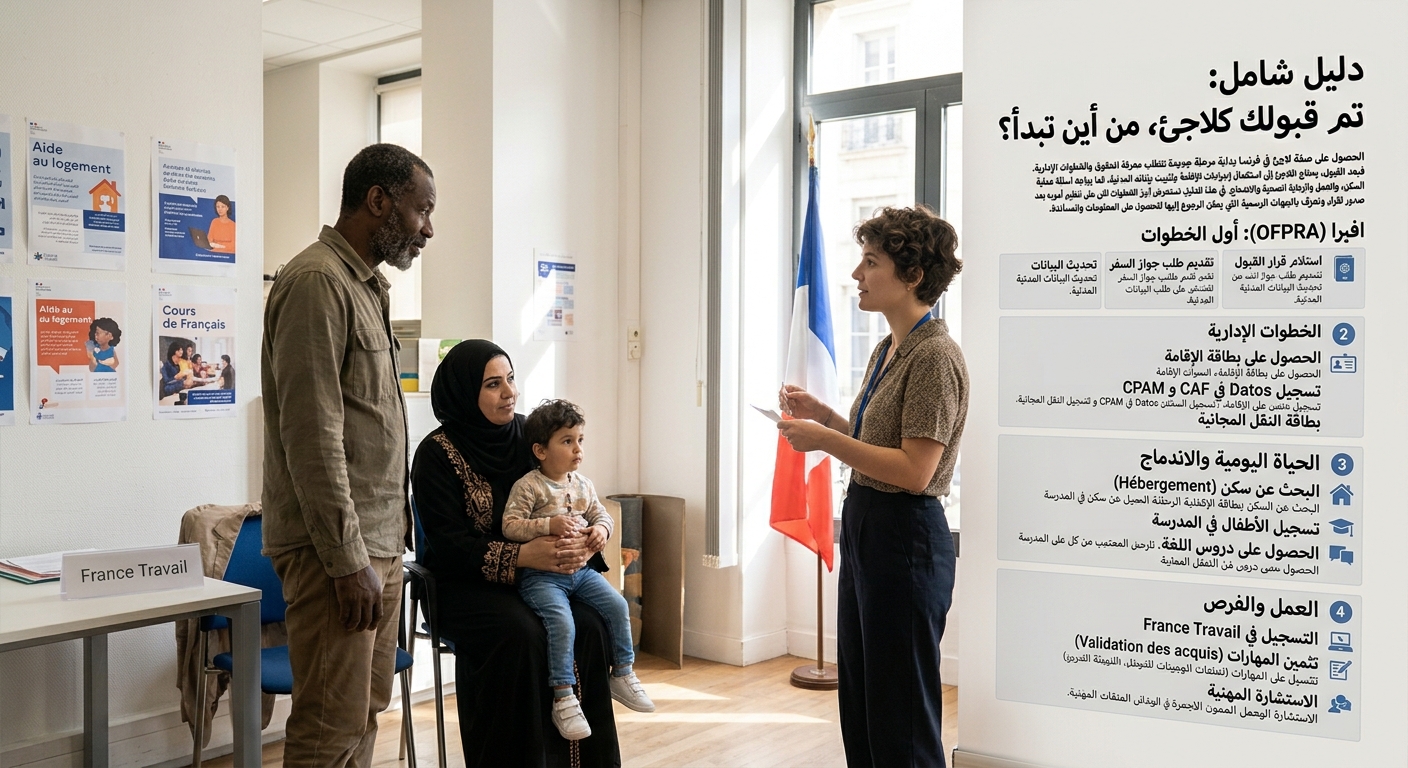
- Safeguard your OFPRA or CNDA decision and update your contact information immediately.
- Apply online for a 10-year residence permit (or 5-year for subsidiary protection) via the ANEF platform.
- Obtain French civil status documents from OFPRA and register with health insurance (CPAM).
- Open accounts with CAF for financial and housing assistance, and with France Travail for employment.
- Follow standard administrative procedures for housing, refugee travel documents, and family reunification.
The issuance of a decision recognizing you as a refugee or stateless person by OFPRA does not conclude your administrative journey; rather, it opens new avenues that require organization and follow-up.
In this article, we start with you from the very first step, outlining a practical roadmap to help you secure your status and build a stable life in France.
Here is the comprehensive guide prioritized by urgency, distinguishing between essential procedures and steps that aid your integration.
1 — First Step: Retaining the Refugee Recognition Decision
Top Priority:
As soon as you receive a positive decision from OFPRA or the CNDA:
• Keep both a physical and digital copy of the decision granting refugee status.
• Retain your former asylum seeker documents, such as your asylum seeker card or certificate, along with any correspondence from OFPRA or the CNDA.
• Ensure your postal address is accurate and up to date, as administrative correspondence is critically important.
• If the decision includes a questionnaire or request for family information, return it to OFPRA as soon as possible.
Important: Do not wait for all civil status procedures to be finalized before beginning to organize your residence permit application and social rights.
2 — Applying for a Residence Permit
An Essential Procedure:
A person recognized as a refugee is entitled to a resident card (Carte de résident) valid for 10 years, whereas subsidiary protection provides a 5-year permit. This card allows its holder to reside and work in France without requiring a separate work authorization.
Applications are submitted electronically through the French platform for foreign nationals (ANEF), in accordance with standard procedures.
Documents you may need include:
• The decision recognizing refugee status from OFPRA or the CNDA.
• Recent proof of address, or an administrative domiciliation certificate (Domiciliation).
• A digital passport photo with an e-photo code.
• Civil status documents requested by the platform or prefecture.
• A commitment to respect the principles of the Republic, following the required template.
After submitting the application, monitor your online account, emails, and text messages. Once the card is ready, you will receive a notification to collect it.
Note: Published official guidelines state that the prefecture issues the resident card within three months of the recognition decision; however, processing times and issuance may require administrative follow-up.
3 — Obtaining Civil Status Documents from OFPRA
This is a crucial step, particularly for those without civil documents recognized in France.
OFPRA reconstitutes your civil status based on the information and documents contained in your asylum application file.
The following documents may be issued to you:
• French birth certificate (Acte de naissance).
• Marriage certificate, if married and the marriage has been established.
• Civil status documents for children, depending on their situation and files.
• Other documents pertaining to family status.
* What should you do?
1. Review the letter enclosed with the recognition decision.
2. If OFPRA requests additional information regarding your marriage or family, respond to the request.
3. Send the requested documents clearly and retain proof of sending.
4. Once your documents are issued, verify the spelling of your first name, surname, and date and place of birth.
Do not overlook any error in your name or date of birth; request a correction from OFPRA before it causes issues with other administrative bodies.
OFPRA notes that preparing initial documents may take time and additional information may be requested from the individual concerned.
4 — Registering for Health Insurance (Assurance Maladie – CPAM)
After being granted refugee status, you must ensure the continuity of your health coverage rights.
Contact the CPAM office affiliated with your place of residence, or use their online services, to verify your situation and open or update your file.
Typically, prepare:
• The refugee recognition decision.
• Your residence document or available temporary permit.
• Birth certificate, if already issued.
• Proof of address.
• Bank details (RIB).
• Social Security number, if previously assigned.
Once your file is processed, you can benefit from health coverage according to your legal and administrative status, and request a health insurance card (Carte Vitale) when eligible.
Website: https://www.ameli.fr/
5 — Opening a File with the Family Allowances Fund (CAF)
If you have limited resources, you may be eligible for certain benefits, depending on your family and professional situation and income.
Key benefits to inquire about:
Benefit |
Purpose |
RSA |
Active Solidarity Income for individuals meeting eligibility criteria |
APL / AL |
Assistance with paying rent |
Prime d’activité |
In-work benefit supporting low-income workers |
Allocations familiales |
Family allowances related to children and household size |
What should you do?
1. Access the CAF website and create an account or update your existing profile.
2. Declare that you have been granted refugee status.
3. Attach the recognition decision and the documents requested by CAF.
4. Submit applications for benefits suited to your situation; do not stop at merely creating the account.
5. Report any changes in housing, employment, family status, or income.
Important warning regarding RSA: Do not assume that the five-year residency requirement applied to certain categories of foreign nationals applies in the same manner to recognized refugees; specific rules apply to beneficiaries of international protection, and CAF must assess your file according to your refugee status and application date.
Website: https://www.caf.fr/
6 — Job Search or Vocational Training
Refugee status grants you the right to work in France, and an employer is not required to apply for a separate work authorization on your behalf.
If you are not working, you can register with France Travail to access:
• Assistance in searching for employment.
• Resume (CV) preparation.
• Career guidance.
• Vocational training programs.
• Assessment of prior skills and credentials.
• Evaluation of eligibility for unemployment benefits if you meet the conditions.
If you hold diplomas or professional experience from your country of origin, preserve them, have necessary documents translated appropriately, and ask your advisor about credential recognition procedures.
Website: https://www.francetravail.fr/accueil/
7 — Housing and Social Stability
If you are residing in an accommodation center for asylum seekers, it is essential to communicate with your social worker to understand exit procedures and transitions to other housing.
You can request assistance with:
• Applying for social housing (Logement social HLM).
• Submitting housing aid applications to CAF.
• Obtaining administrative domiciliation if you do not have a stable address.
• Contacting municipal social action centers (CCAS).
• Exploring eligibility for refugee integration programs, such as the AGIR program where available and if you meet the criteria.
Do not vacate your accommodation or sever communication with your managing agency before understanding the implications on your status and rights.
Website: https://www.demande-logement-social.gouv.fr/index
8 — Applying for a Refugee Travel Document
Important when needing to travel:
A refugee wishing to travel outside France may apply for a Refugee Travel Document: Titre de voyage pour réfugié (TVR).
This is a travel document issued by the French authorities to the refugee, not a passport from their country of origin.
Typically, the application requires documents such as:
• A residence permit or the document required according to your file's stage.
• Proof of refugee status.
• Proof of address.
• A digital photo or passport photos depending on the procedure.
The application must be submitted via ANEF according to the dedicated procedure for travel documents.
Crucial Warning:
Do not travel to your country of origin or contact its authorities to request protection or renew national documents without consulting a legal specialist. Such actions can raise questions about the ongoing need for international protection and may affect your refugee status.
Website: https://administration-etrangers-en-france.interieur.gouv.fr/particuliers/
9 — Family Reunification (Réunification familiale)
If your spouse or children are still outside France, you may be able to apply for them to join you through the family reunification procedure.
It is important to distinguish between family reunification specific to refugees (réunification familiale) and standard family reunification (regroupement familial); specific rules apply to beneficiaries of international protection.
Begin gathering information and documents regarding:
• Marriage or marital relationship.
• Children and proof of filiation.
• Dates of marriage and births.
• Identity and personal details of family members.
Do not provide inaccurate information or documents. If there is an issue with marriage or birth certificates, consult a specialized organization before filing the application.
More details via the following link: What do you know about family reunification in France? Here are the procedures and laws.
10 — Opening a Bank Account and Tax Registration
It is advisable to complete these two steps early:
1 — Bank Account (Compte bancaire):
• Open a bank account in your name.
• Request a bank identity statement (RIB).
• Use the account to receive salary, social benefits, and to pay rent and utility bills.
2 — Taxes (Impôts):
• Request your tax identification number (Numéro fiscal) if you do not already have one.
• Create an account on the French tax administration website.
Familiarize yourself with the annual income tax return requirement (Déclaration de revenus), even if you have no employment income, based on your tax situation.
Website: https://www.impots.gouv.fr/accueil
12 — Learning French and Education
The French language is fundamental for independence and integration into society and the labor market.
You can look for:
• French language courses tailored for refugees.
• Language classes in non-profit associations and social centers.
• Vocational training that incorporates language learning.
• Adult education programs (Formation linguistique).
• Schools and universities if you wish to pursue academic studies.
If you have children, contact your local municipality or school to enroll them and follow up on their education.
* Recommended Checklist of Documents
Maintain both physical and digital copies of these documents:
Your administrative file should include:
• Refugee recognition decision from OFPRA or the CNDA.
• Former asylum seeker documents.
• French birth certificate upon issuance.
• Marriage certificate and children's civil documents, if applicable.
• Proof of address or administrative domiciliation.
• Resident card or temporary residence document.
• Social Security number or CPAM documents.
• Bank account statement (RIB).
• Passport photos or e-photo code.
• Academic degrees, work certificates, and experience records.
Comments (0)
You must log in to comment on articles.
Log in Sign upBe the first to comment on this article.