

2026 Midterms: Trump Denounces "Rigged" Election Following Democratic Landslide
Following a sweeping Democratic victory securing majorities in both the House and the Senate, U.S. President Donald Trump renewed claims of electoral fraud, while fractures began to surface within the Republican Party.

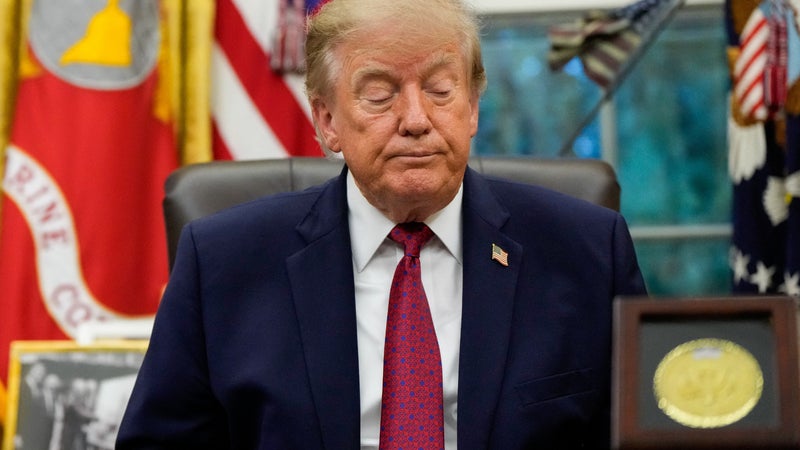
- Democrats secure control of the House of Representatives with at least 250 seats and clinch a Senate majority with at least 54 seats.
- Donald Trump resumes allegations of election fraud, particularly following a name-confusion controversy in Alaska and a razor-thin race in Mississippi.
- Cracks appear within the Republican Party amid criticism from DeSantis and Vance, as Hakeem Jeffries prepares to assume the House speakership with a focus on lowering living costs and investigating the administration.
U.S. President Donald Trump complained on Thursday, November 5, that elections in the United States were "rigged," following a landslide victory by the Democratic Party that guarantees them at least 250 seats in the House of Representatives starting next January, according to estimates and projections by major American media outlets.
Although the Republican president had pledged on Tuesday evening to accept the results, he returned once again to repeat allegations of fraud and manipulation by Democrats, telling reporters from the Oval Office at the White House: "Our elections are rigged to a degree that you cannot imagine."
Comfortable Democratic Majority in Congress
Two days after the midterm elections, Democrats grew confident of capturing at least 250 seats in the House of Representatives, according to projections by CNN and Fox News—a tally that could climb further as vote counting continues across approximately twenty congressional districts. This total provides Democrats with a margin of at least 65 representatives over Republicans.
Democratic gains were not confined to the House of Representatives; they also extended to the Senate, where they flipped seven additional seats to expand their majority to at least 54 members out of 100, pending the final outcomes in Alaska and Mississippi.
"Name-Alike" Controversy and Tight Races
In traditionally conservative Alaska, Trump stirred controversy over the trajectory of the results after an individual bearing the exact same name as Republican Senator Dan Sullivan ran as a candidate—a move viewed as an attempt to dilute the vote. Via his Truth Social platform, Trump demanded that the alternative candidate's votes be combined with those of the incumbent senator. With 75% of the votes counted, Democratic candidate Mary Peltola held a narrow lead of approximately 600 votes, while the other candidate named Dan Sullivan secured around 3,600 votes (1.7%).
Meanwhile, in Mississippi—historically considered a guaranteed stronghold for the right—Democratic candidate Scott Colom led Republican rival Cindy Hyde-Smith by 1,138 votes, with 96% of the ballots counted.
Cost-of-Living Priorities and Holding the Administration Accountable
Hakeem Jeffries is poised to become Speaker of the House, making him the first African American to hold the prominent post. In a letter to his colleagues, Jeffries stressed that his party's legislative agenda will primarily focus on "doing everything possible to meaningfully reduce the cost of living," noting that inflation, exacerbated by the repercussions of the war in Iran, was the primary cause of the Republicans' severe defeat.
Jeffries also pledged to initiate wide-ranging congressional investigations and hold executive branch officials accountable, underscoring the necessity of confronting corruption. The incoming Senate, which officially convenes on January 3, will have the ability to block all federal appointments submitted by President Trump.
Rifts Within the Republican Camp
The resounding defeat exposed fissures within the Republican Party. Florida Governor Ron DeSantis described the outcome as "an obliteration of Republicans across several areas that we have not witnessed in a century." For his part, Vice President JD Vance distanced himself from Trump, stating publicly that the war in Iran was the "primary cause" behind the major electoral setback.
Source: BFM TV



Comments (0)
You must log in to comment on articles.
Log in Sign upBe the first to comment on this article.