

France: Reims Commemorates the 800th Anniversary of King Louis IX's Coronation at Notre-Dame Cathedral
Notre-Dame de Reims Cathedral marked the 800th anniversary of the coronation of King Louis IX, later known as Saint Louis, in a religious and cultural ceremony led by Archbishop Éric de Moulins-Beaufort.

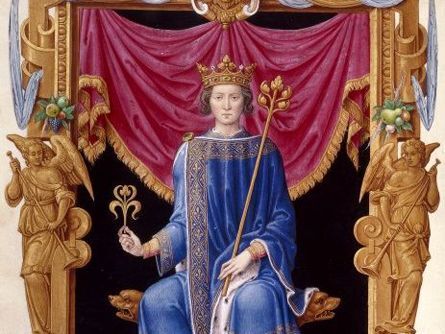
- Commemoration of the 800th anniversary of Louis IX's coronation at Reims Cathedral during a mass led by Archbishop Éric de Moulins-Beaufort.
- A review of the king's reformist legacy, which included monetary unification and the establishment of bodies that later evolved into the French Parliament and the Court of Auditors.
- Recalling the defining milestones of his reign, combining care for the poor and judicial reform with military campaigns in Egypt and Tunisia.
Notre-Dame de Reims Cathedral marked the eighth centenary of the coronation of King Louis IX, later known as "Saint Louis," in a religious and cultural ceremony presided over by the Archbishop of Reims, Monsignor Éric de Moulins-Beaufort, marking 800 years since his accession to the throne.
During his homily, the Archbishop recalled that Louis IX was only 12 years old on the day of his coronation in the same cathedral in 1226, when his mother, Queen Blanche of Castile, assumed the regency of the throne in accordance with the will of his father, King Louis VIII, until he reached the age of majority.
An Extended Reign and Major Institutional Reforms
Louis IX's reign spanned forty-three years (1214–1270), influenced by religious values and the centrality of royal justice. He worked to curb the influence of the feudal system in favor of the concept of the "common good," establishing himself as a "supreme arbiter of justice" to whom even other European kingdoms turned for arbitration.
Domestically and organizationally, the king expanded the realm to include the counties of Blois, Chartres, and Sancerre, alongside Normandy, Maine, Provence, and Languedoc. He also established a system of local representatives through the appointment of bailiffs and provosts ("les baillis" and "les prévôts"), and instituted the principle of "petition," which allowed subjects to appeal judgments directly to the king for review. His reign also saw initiatives to establish a unified currency and institutions that later evolved into the French Parliament and the Court of Auditors ("Cour des comptes").
Between Religious Piety and Legislative Strictness
Louis IX was distinguished by a pronounced religious devotion, which led him to criminalize blasphemy, gambling, interest-bearing loans, and prostitution. As part of his religious pursuits, he acquired sacred relics and built the famous Sainte-Chapelle in Paris to house them.
In his homily, Archbishop de Moulins-Beaufort noted that the king's contemporaries admired his care and concern for the poor, while also acknowledging his severe strictness toward what was considered deviant behavior at the time, as well as his ambiguous stance toward the Jews, which left tragic consequences in historical memory.
Military Campaigns and Canonization
Accompanied by his brothers Robert d'Artois, Alphonse de Poitiers, and Charles d'Anjou, Louis IX led military campaigns that set out first to Egypt during the Seventh Crusade following a vow he made upon recovering from a severe illness, and later to Tunis as part of the Eighth Crusade, where he died of dysentery.
Regarded as a holy figure by his subjects during his lifetime, Louis IX was officially canonized by Pope Boniface VIII in 1297, shortly after his death.
Source: La Croix



Comments (0)
You must log in to comment on articles.
Log in Sign upBe the first to comment on this article.