

Salvadoran Forces Launch Major Offensive Against Gangs in Haiti, Destroy Key Headquarters
Salvadoran military forces deployed in Haiti have launched a large-scale offensive, destroying the headquarters of a prominent gang leader east of Port-au-Prince in their first major announced operation.

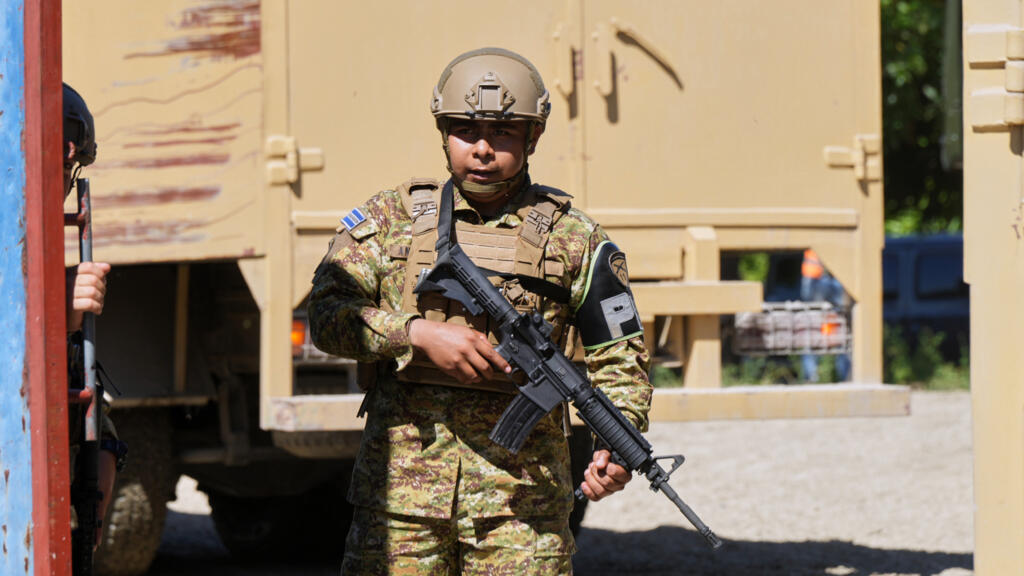
- Salvadoran helicopters destroy the headquarters of '400 Mawozo' gang leader in Croix-des-Bouquets, east of Haiti's capital.
- Haiti's prime minister and the Dominican president praise the Salvadoran intervention, amid reports of at least 20 people killed.
- Amnesty International and the UN note that the forces operate outside the UN mandate framework and call for adherence to human rights standards.
The President of El Salvador, Nayib Bukele, announced that his country's military forces deployed in Haiti carried out a large-scale operation in which they successfully destroyed the residence and "headquarters" of one of the country's most prominent criminal gang leaders. This operation marks the first large-scale, publicized assault involving Salvadoran forces since the deployment of more than 2,000 troops late last October, aimed at rescuing four soldiers who went missing following an armed attack near Port-au-Prince.
Targeting the Stronghold of the '400 Mawozo' Gang
Bukele posted a video of the operation on the X platform accompanied by a message in Haitian Creole, explaining that the strike targeted the headquarters of Wilson Joseph, known as "Lanmò San Jou," the leader of the "400 Mawozo" gang. The footage showed three helicopters bearing the Salvadoran flag hovering over the area and repeatedly opening fire on the site, while several individuals were seen fleeing the vicinity of the building located in the commune of Croix-des-Bouquets, east of the capital, Port-au-Prince.
The American newspaper The Miami Herald reported that the building was destroyed on Sunday during a joint operation conducted by the Haitian police with support from Salvadoran forces, citing unnamed sources as saying that at least 20 people were killed. In addition, the government-aligned newspaper Diario El Salvador reported that the gang leader was not inside the house during the attack.
Official Welcome and Regional Support
The move drew official praise from Haitian Prime Minister Alix Didier Fils-Aimé, who is struggling to restore security and end gang control over extensive neighborhoods in the capital; he thanked the Salvadoran president for supporting national efforts to combat organized crime.
For his part, the President of the neighboring Dominican Republic, Luis Abinader, affirmed his support for the actions of the Salvadoran military and the provision of logistical and intelligence assistance, while calling for coordination between Salvadoran forces and the UN-backed international police support force. The Dominican government enforces strict policies to curb irregular migration and is constructing a 380-kilometer border wall with Haiti.
Human Rights Concerns and UN Warnings
Conversely, the United Nations clarified that most Salvadoran military personnel deployed in Haiti do not officially belong to the UN-backed anti-gang mission and operate outside the approved mandate and international monitoring mechanisms.
On the human rights front, Amnesty International called on the governments of both El Salvador and Haiti to disclose and clarify the agreement governing the Salvadoran military intervention, and to ensure respect for international human rights standards when pursuing gang members, who have historically relied on kidnapping, extortion, and territorial control through force.
Source: France 24

Comments (0)
You must log in to comment on articles.
Log in Sign upBe the first to comment on this article.