

Philippe Lazzarini: "Palestinians Risk the Same Fate as Native Americans"
Former UNRWA Commissioner-General Philippe Lazzarini warns that Palestinians face the threat of disappearance into oblivion, comparing their plight to that of Native Americans, while sharply criticizing international passivity.

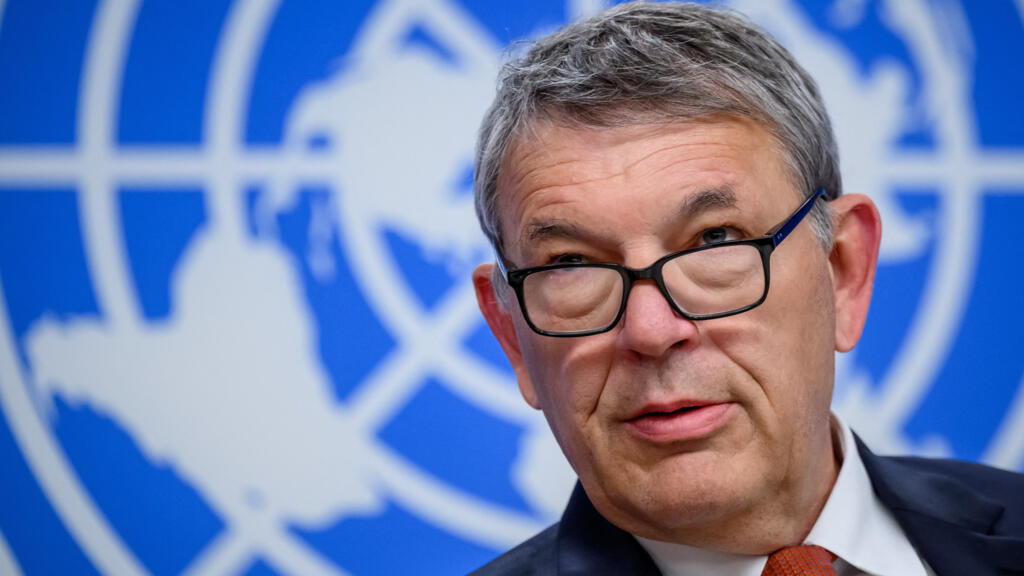
- Philippe Lazzarini, former head of UNRWA, warns that Palestinians risk being pushed toward disappearance like Native Americans if international inaction persists.
- Lazzarini denounces the international community's complicity and failure to enforce red lines or sanctions under international law regarding Gaza.
- The former commissioner-general cautions that UNRWA remains in mortal danger amid a $100 million structural deficit and systematic efforts to dismantle its operations across the Palestinian territories.
Published on: 02/11/2026 - 08:08
Philippe Lazzarini, former Commissioner-General of UNRWA (2020–2026) and author of Témoin de Gaza : ce qui ne s'efface pas (Favre Publishing), is the guest of RFI this November 2, 2026. The former head of the UN agency for Palestinian refugees points out the passivity of the international community in the face of the tragedies in Gaza. He expresses alarm over UNRWA's financial difficulties.
RFI: Thank you for being with us. We are hosting you between two elections: the legislative elections in Israel and the midterms in the United States. Can the results of these votes change the lives of Palestinians?
Philippe Lazzarini: I do not think the results in Israel can change anything in the lives of Israelis. Today, first, there is no majority. Second, of all the political parties that took part in these elections, none had the Palestinian issue on their political manifesto. And thirdly, looking at the Israeli population, more than 80% would like to see people leave Gaza.
If nothing changes, neither in Tel Aviv nor in Washington, what do Palestinians risk today?
Listen, I think that Palestinians today risk more misery, more distress. They also fear fading into oblivion. We currently have had a ceasefire in Gaza for a year, and because of this ceasefire, the issue has been deprioritized by the international community.
They even risk disappearing, you write in your book.
They risk disappearance. I drew the analogy with Native Americans, saying that if we do not act today, it will be too late, and that the destiny of these Palestinians will be the same as that of the Native Americans, who were left in reservations, starving, dying of diseases, and who then had no choice but to leave those reservations.
Philippe Lazzarini, in your book, as a firsthand witness to what happened in Gaza, you point to and denounce the passivity of the international community in the face of this war. How do you explain this passivity?
It is difficult to explain this passivity because, ultimately, what we have seen over the past three years has been massive crimes. It continues before our eyes, we were informed, and despite everything, there have been no consequences. And obviously, one of the risks is that we have had international law without red lines. And that is exactly what happened in the context of Gaza. Sanctions could have been imposed, Israeli policies could have been influenced, but that was not the case.
You speak of an astounding silence, of injustice, abandonment, the collapse of our universal values. Who bears the responsibility for this passivity and this silence, in your view?
Our governments definitely bear a large share of responsibility. Inaction is complicity. Look at the discussions that took place at the level of the European Commission. We have instruments at our disposal that we chose not to use, such as the Association Agreement, which is very, very clear. It can only continue if human rights and international humanitarian law are respected. Yet, several reports demonstrated that this was not the case.
And this Association Agreement is still applied because the 27 member states cannot agree on its suspension. At what point did you realize that the United Nations was ultimately incapable of enforcing its own principles? You speak of a collapse of international law.
Very early on, at the beginning of the conflict, I came to the conclusion that, as the head of an agency, I could no longer necessarily provide assistance or protect the population, or our employees for that matter. And that is why we decided from the outset to draw attention to these systematic violations. Then, of course, there were various events over the past three years, but I think the turning point was when famine was declared in Gaza, and despite the famine declaration, there were no consequences or pressure exerted on the Israeli government.
You also describe a form of abdication. You use this term, the abdication of the international community, and you base it on an event. That was a year ago now, in November 2025: UN Resolution 2803. The Security Council validated Donald Trump's "Board of Peace," his committee or peace council. What was it about this event that opened your eyes even further to the lack of political will to react?
This event was absolutely shocking because it is, after all, a Security Council deciding to transfer its prerogatives regarding peace and security to an entity whose composition was entirely unknown at the time. And then, we saw subsequently that President Trump declared himself president for life of this committee. And then, appetite growing with the eating, he also proposed that this Board of Peace address not only Gaza, but all other conflicts around the world, which only weakens the position of the Security Council and overshadows its prerogatives.
You also point to another event, a little later, in January 2026. After the passage of anti-UNRWA laws by the Israeli parliament, bulldozers arrived to destroy UNRWA offices in East Jerusalem. Minister Ben-Gvir was on the scene, gloating. And there too, not much of a reaction.
No, aside from words and condemnations. And that scene was symbolically absolutely shocking. Indeed, we had a minister, we also had parliamentarians expressing their joy, while on that day, they flouted international law, they flouted privileges and immunities. But also, what he sought to do by eliminating the UNRWA agency from occupied East Jerusalem was to annihilate any history and any presence of Palestinian refugees in this part of the occupied territories.
This also followed very serious accusations. As early as January 2024, UNRWA was accused by Israel of having employees affiliated with Hamas, and even of having participated in the October 7, 2023 attacks. Do you believe you took the right approach at that time?
I think at that time, we had no choice but to act immediately. We acted immediately. Investigations were launched, an independent review of all our systems was also conducted by former Minister of Foreign Affairs Catherine Colonna. We had no choice but to respond immediately. But, in fact, beyond all these accusations, the agency itself has faced endless accusations. It wasn't just about those employees. We were accused of harboring hundreds of thousands of jihadists within the agency, and we know very well that all these accusations have nothing to do with the primary motivation, which is to eliminate UNRWA and, through UNRWA, the refugee status of Palestinians, and through that, the issue of the right of return.
You yourself were accused of heading a terrorist organization. The consequence was donor countries suspending their contributions. UNRWA's funding crisis persists to this day, with a $100 million deficit. What are the consequences?
Well, the crisis was particularly acute at the time of the allegations, in January 2024. That suspension took place then, but all donors eventually returned. However, it is true that the agency suffers from a structural financial crisis. And the more the conflict is deprioritized and attention shifts elsewhere, the greater the pressure on the agency will be. I am not very optimistic about the agency's future.
In conclusion, is UNRWA tangibly in mortal danger?
The agency is in danger. Israel has succeeded in eliminating the agency in East Jerusalem. Pressure is currently at its maximum in Gaza, and after Gaza, it will be the West Bank. And once UNRWA is no longer present in the territories, it will be elsewhere.
Also read: End of mandate for UNRWA chief, who calls for an investigation into the deaths of at least 390 employees
Newsletter: Receive all international news directly in your inbox
Follow all international news by downloading the RFI app
Source: RFI



Comments (0)
You must log in to comment on articles.
Log in Sign upBe the first to comment on this article.