

"Little Martyr of the A10": "I will try to come and take responsibility"… The fading memory of Inass Touloub's parents
At the Blois Assize Court, the trial of Inass Touloub's parents opened with mutual accusations, denials, and failing memories, nearly 40 years after the four-year-old girl's mutilated body was found along the A10 motorway.

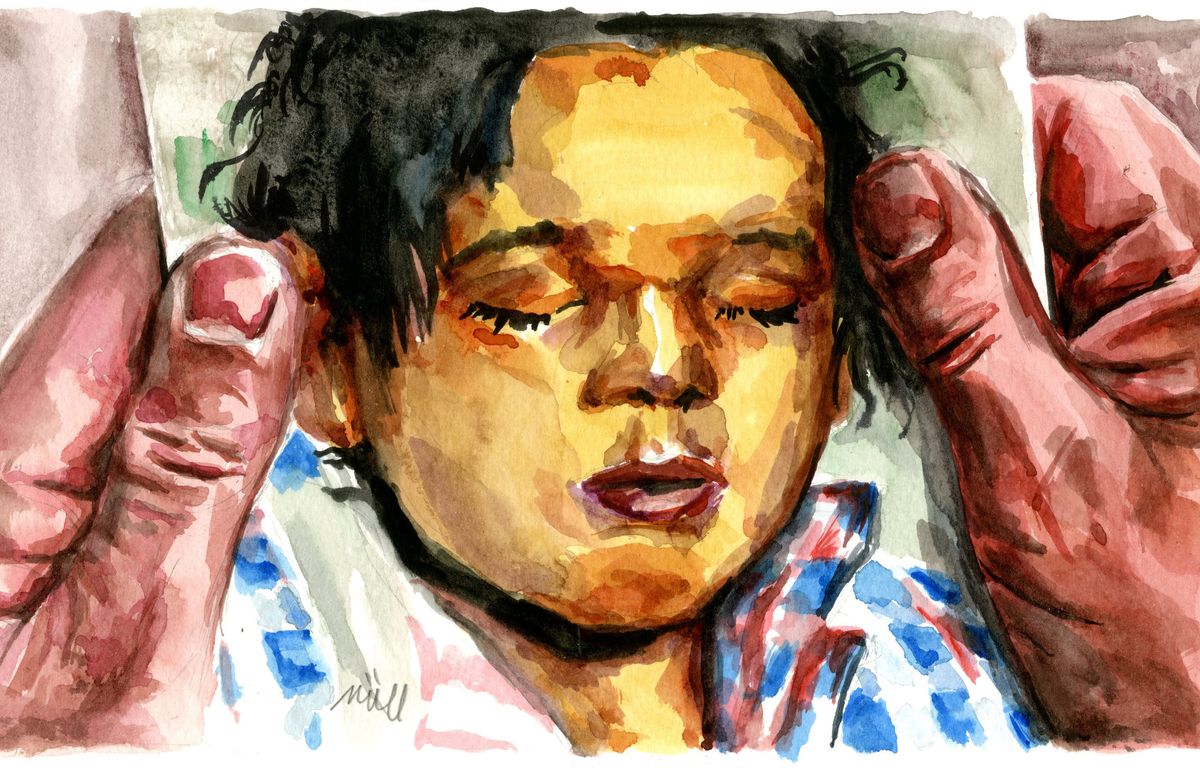
- The trial of the parents of Inass Touloub, found dead alongside the A10 in 1987, opened at the Blois Assize Court.
- The mother, Halima El Bakhti, and the father, Ahmed Touloub, traded blame while pleading memory loss and showing signs of cognitive decline.
- The court revisited the harrowing autopsy report revealing extreme abuse, including fractures, burns, and 27 human bite marks on the four-year-old child.
- Additional psychiatric and medical assessments were ordered, with the verdict anticipated on Friday, November 13.
At the Blois Assize Court,
"It's not true," insists the former. "Me, I did nothing," swears the latter, leaning on the railing of the Blois Assize Court. On Monday, the opening day of the trial of the parents of Inass Touloub—the little girl found dead in 1987 along the A10 motorway—it took only a few minutes to set the tone for the defense. "Do you admit to having committed acts of torture and barbarity against your daughter?" asked the presiding judge, Audrey Debeugny. "No, she was my daughter," Halima El Bakhti replied in a quavering voice.
Just moments earlier, however, the 72-year-old woman, bundled in a long beige coat with her face framed by a white headscarf, had claimed the opposite. "I admit [the facts], but people are talking nonsense," she stated before accusing her ex-husband, Ahmed Touloub—on trial for complicity—of having "lied a lot." "I was beaten; how could I be an accomplice?" retorted the 74-year-old man, with his balding head and thick white beard. It is a duel of contradictory words that is difficult to untangle. Ever since he was taken into police custody in June 2018, Ahmed Touloub has consistently accused his wife of the violence, admitting only to witnessing it without ever intervening. She has admitted only to slapping Inass, but denies delivering the fatal blows.
A harrowing autopsy
Sitting side by side throughout the day, they did not exchange a single glance. She stared blankly into the distance. He stared at his feet, his back hunched, leaning on his cane. Not a single expression surfaced as the judge summarized the case, from the discovery of the body on the shoulder of the A10 motorway one afternoon in August 1987 to her identification in 2017, following her brother's conviction in an ordinary neighborhood brawl. It was his DNA that ultimately led investigators to the accused.
The jurors stopped taking notes, visibly stunned, as the presiding judge reviewed the autopsy findings: older and more recent fractures that were never treated, hematomas, burns from a clothes iron, and bites. Many bites. One of the little girl's nipples had been nearly torn off with teeth, and her face was so disfigured—27 bite marks were recorded—that the photograph on the appeal for witnesses had to be retouched before it could be displayed publicly. A staggering inventory that offers a glimpse into the ordeal that was the life of this 4-year-old girl. Highlighting the sensitivity of the case, activists from the child protection organization Mouv'Enfants confronted the accused in front of the courthouse, calling them murderers and acting threateningly. Halima El Bakhti had to be evacuated by police officers, and an investigation was opened.
"It is very complicated for me"
"Are you able to explain yourself?" the presiding judge of the assize court asked. "I will try to come and take responsibility," Halima El Bakhti replied laconically. At the close of this first day, one significant question remains: what can be expected from a trial taking place 39 years after the events? In just a few sentences, the septuagenarian contradicted herself several times, claiming she no longer remembered her address or a doctor's appointment. Does she comprehend the gravity of the charges, facing life imprisonment?
Ahmed Touloub, meanwhile, can barely stand and insists he also suffers from memory lapses. "Sometimes, I don't even remember what I ate the day before," he insisted. What will happen when the court addresses the merits of the case? "Do you think you are able to defend yourself?" the judge asked him. "It is very complicated for me," the defendant replied.
Should this be viewed as a defense strategy? Perhaps, but experts have diagnosed Halima El Bakhti with "mild cognitive impairment" and Ahmed Touloub with "moderate dementia." "You appointed an expert who tells you that he cannot distinguish the small hand from the large hand [of a clock]," argued his lawyer, Franck Berton. A supplementary expert evaluation has been ordered. The verdict is expected on Friday, November 13.
Source: 20 Minutes

Comments (0)
You must log in to comment on articles.
Log in Sign upBe the first to comment on this article.