

Appealing an OFPRA Rejection Before the National Court of Asylum (CNDA): A Step-by-Step Guide
A step-by-step journalistic guide detailing how to appeal an OFPRA asylum rejection before France's National Court of Asylum (CNDA), from legal aid and filing deadlines to court hearings and potential outcomes.

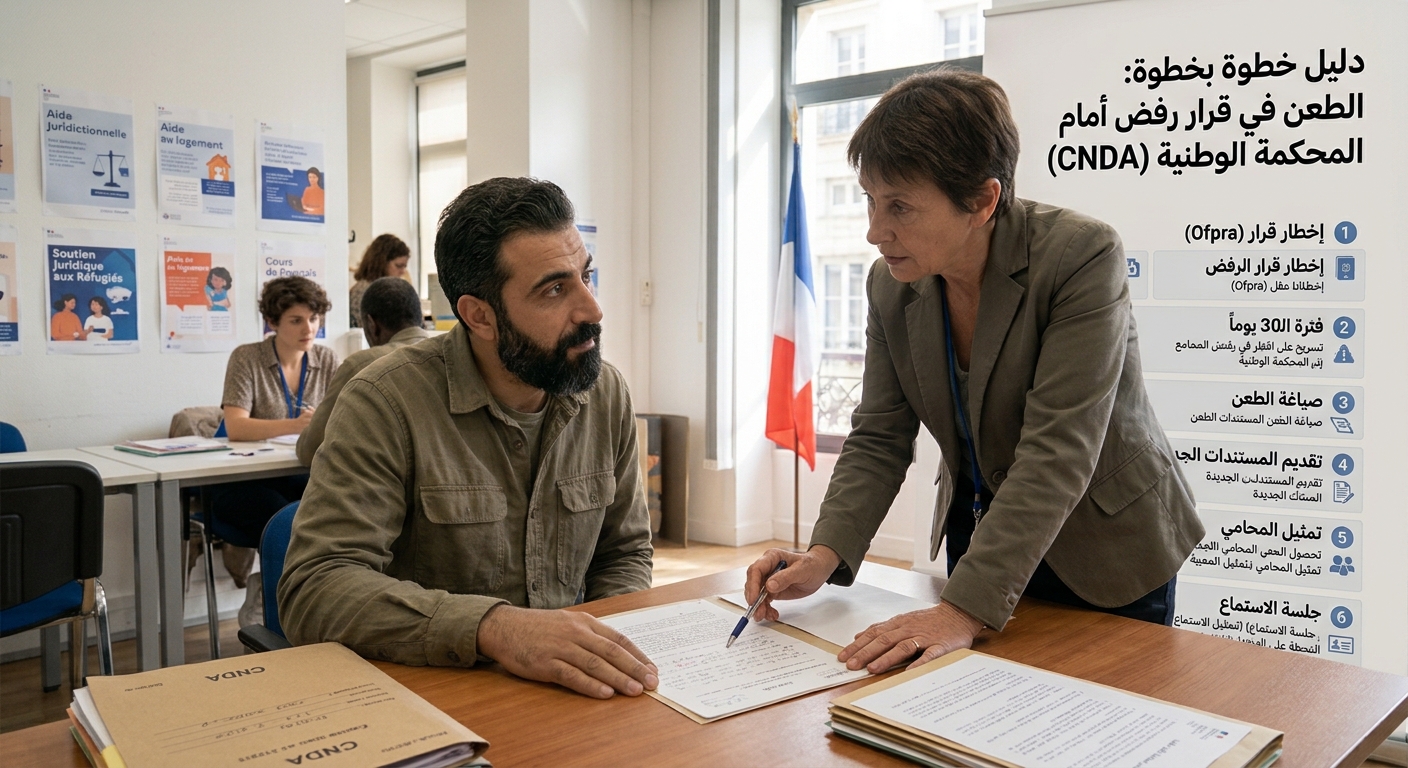
- An asylum rejection by OFPRA is not necessarily final; applicants have the legal right to challenge the decision before the National Court of Asylum (CNDA).
- Filing an appeal requires strict adherence to statutory deadlines, preparing a substantiated file to refute OFPRA's arguments, and submitting relevant supporting evidence.
- This guide covers every stage of the process—from receiving the rejection letter and requesting legal aid to attending the hearing and understanding subsequent legal implications.
If your asylum application has been rejected by the French Office for the Protection of Refugees and Stateless Persons (OFPRA), you can appeal this decision before the National Court of Asylum (CNDA). The appeal must be lodged within one month from the date you receive the decision.
— The "acknowledgment of receipt (AR)" is established starting from the date you log into the OFPRA web portal.
New update: Since the introduction of the secure personal digital space, OFPRA considers the date of notification to be either the date of the first login to access the rejection decision by the recipient, or the absence of a first login within 15 days from the date the document was made available online.
Warning!: OFPRA may continue to send registered letters to notify you of asylum rejections for a certain period.
In this case, the letter must be collected from the post office within 15 days after the mail carrier leaves the transit slip (AR). Otherwise, the letter will be returned to OFPRA, but the legally considered date of notification will remain the date the uncollected registered mail was first presented.
*— Upon receiving the rejection letter, a series of administrative steps must be followed:
01 - Requesting Legal Aid:
Legal aid is not mandatory, but hiring a lawyer to challenge OFPRA's rejection decision is strongly recommended. Applying for legal aid (aide juridictionnelle) allows you to obtain a court-appointed lawyer free of charge. The request must be submitted to the National Court of Asylum, Legal Aid Office, at the following address: 35 Rue Cuvier, 93100 Montreuil.
- You can fill out the legal aid application form (Cerfa form No. 12467*02) or draft your request on a blank sheet of paper. Then, send this application by fax to 01 48 18 43 11 or via registered mail with acknowledgment of receipt.
- Do not forget to attach a copy of the OFPRA rejection decision.
- The legal aid request must be received by the Legal Aid Office within 15 days of the date you were notified of OFPRA's decision.
— Once this deadline expires, you will no longer be able to request legal aid, even when filing your appeal.
- This 15-day period begins from the "accusé de réception" generated by the secure OFPRA user portal—which corresponds to the date and time the recipient first logs in to access the decision in their personal space within 15 days of the document being uploaded to the site.
— If the decision is sent by postal mail, the deadline begins on the date the registered letter (AR) was delivered.
- Legal aid application suspends the appeal deadline:
The calculation of the one-month appeal deadline is suspended until the Legal Aid Office makes a decision regarding your request—granting or refusing it—and resumes on the date you are notified of that decision.
— Example: If you are notified of the OFPRA rejection decision on February 1 and apply for legal aid on February 7 (i.e., after 6 days), those 6 days must be deducted from the one-month period available to file the appeal.
— If the Legal Aid Office issues a decision granting you legal aid on March 1, the deadline to lodge the appeal resumes from that date, leaving you with 25 days, since 6 days have already elapsed (from February 1 to 7).
- As a precautionary measure, it is best to submit your appeal as quickly as possible or at least within 15 days from the date the legal aid decision is notified.
- The Legal Aid Office will appoint a lawyer to represent you throughout the proceedings and will send you their name and phone number in an official letter to your address registered with OFPRA. (Contacting the lawyer promptly is extremely vital to strengthen your appeal file and brief them on every detail of your case; although the lawyer receives a copy of your OFPRA file, direct communication remains indispensable).
You can also retain a private lawyer of your choice, provided you agree before their fees are covered via legal aid. As mentioned earlier, an appointment must be scheduled with the lawyer quickly so they can file both the legal aid request and the appeal in time.
02 - Lodging the Appeal Against the Rejection Decision:
The appeal must be drafted in French and sent to the National Court of Asylum (CNDA) by registered mail with acknowledgment of receipt (AR) or by fax. You can also submit it directly to the registry of the CNDA, or your lawyer may file it on your behalf.
- If you do not wish to be heard via video link without physically attending your hearing, you must specify this in the appeal and explicitly request an in-person hearing on the premises of the National Court of Asylum in Montreuil, in the Paris suburbs.
*— Note: Do not forget to attach a copy of the OFPRA rejection decision.
- The appeal must include the following details: full name, date and place of birth, nationality, address, and the registration number of the appeal file—not the OFPRA file number (ordinarily, the lawyer handles these formalities as they draft the appeal petition before submitting it to the court).
The appeal must outline the specific grounds on which you challenge the decision of OFPRA.
- You must provide clear and comprehensive rebuttals to the arguments (reasons for rejection) cited by OFPRA, such as:
— Details of the political activities you engaged in, reconstructing the timeline contested in the OFPRA decision, and correcting any factual errors found in the rejection letter or recorded during the interview at OFPRA headquarters, etc.
- You can submit supplementary documents until the date the investigation closes, as indicated in the hearing notice, via registered mail with acknowledgment of receipt (AR) or by fax, ensuring the appeal registration number is clearly stated on the correspondence.
- If you have chosen a private lawyer or had one appointed by the court, consult them on whether to add specific documents to the appeal. Judges attach great importance to these documents, particularly:
the date, the issuing authority, and the means by which they were obtained, as judges are very likely to question you about them, such as:
Where did you obtain these documents? How did you obtain them?
- You may, for example, add documents from your country of origin or from an accredited institution in France proving the well-founded fears you experience due to political activity or a personal situation (proof of political activity, religious practice, or sexual orientation in France, such as press articles mentioning you and your case, photographs, videos, etc.).
- You can also submit certified and recognized medical certificates demonstrating physical traces of injuries sustained as a result of torture, as judges take these into serious consideration.
*— Note:
Do not burden your dossier with documents unrelated to your claim for international protection—for instance, a medical certificate merely stating you are ill, proof of integration into French society, or general articles and reports about public affairs or tribal/ethnic demographics in your country. As a rule, such general materials carry little weight, because OFPRA and the CNDA have a dedicated division called the Division of Information, Documentation and Research (DIDR). Its primary mission is to support decision-makers through periodic reports on countries of origin and complex topics raised in asylum claims, helping them make grounded decisions based on field data compiled by specialized researchers. You can visit their website and search by country and topic of interest.
*— Caution:
If additional documents were forwarded to you by a third party and you doubt their authenticity, it is advisable not to submit them, as questionable documents may arouse suspicion among the judges and adversely affect your entire case.
- All parts of the dossier must be translated into French. If you wish to include excerpts from NGO reports, news articles, or country-of-origin background materials, informal translations into French or English are generally acceptable.
However, official and legal documents must be translated by a certified sworn translator. While judges may occasionally accept an informal translation, critical evidence should always be translated by a sworn translator (at a cost typically ranging between €10 and €50 per document, depending on content and length).
- Upon receiving your appeal, the CNDA will send you an acknowledgment of receipt containing your case number, which allows you to renew your asylum application certificate (Attestation de demande d'asile).
In principle, lodging an appeal with the CNDA automatically stays deportation, meaning you cannot be removed to your country of origin before the court delivers its final judgment.
- If your case is processed under the standard procedure, the CNDA usually takes around 5 months to issue a ruling.
If your claim was channeled into the accelerated procedure, a single judge delivers a decision within 5 weeks. However, in certain specific cases, an appeal does not stay deportation if the right to remain on French territory has been denied.
- In addition to challenging the rejection decision by OFPRA, you may also dispute your placement under the accelerated procedure (consulting a lawyer specializing in immigration, asylum, and aliens' rights is strongly recommended).
For more details, see the article:
Grounds for Refusal and Termination of the Right to Remain on French Territory (Withdrawal of Asylum Certificate).
- In principle: An appeal before the CNDA has automatic suspensive effect, meaning you cannot be expelled to your home country until the court has ruled. However, in certain exceptions, the appeal is non-suspensive if the right to remain on national territory has been terminated.
03 - The Hearing Before the National Court of Asylum (CNDA):
Hearings are usually held at the court's headquarters or in one of its annexes in the Paris suburbs, attended by 3 key court officers:
— The Rapporteur (Le Rapporteur): An official employed by the asylum court—not an OFPRA representative—who handles the procedural presentation, reads a summary of the asylum case, presents the grounds for rejection raised by OFPRA, and delivers an impartial analysis of the file without expressing a personal opinion on whether protection should be granted or refused.
— The Court Clerk (Le Secrétaire d'audience / Greffier): Manages the administrative and organizational aspects during the hearing, calls out the cases, and records the official minutes (logging every statement made during the proceedings).
— The Judicial Panel (La Formation de jugement): Varies according to the procedure governing the case:
— Single Judge (Juge unique): A single judge presides over the hearing and rules on acceptance or rejection in cases under the accelerated procedure or inadmissible appeals.
— Collegiate Panel (Formation collégiale): Composed of 3 judges:
The Presiding Judge and two assessors, one appointed by the French Council of State and the other by the United Nations High Commissioner for Refugees (UNHCR) through the UNHCR Representation in France.
On the other side of the courtroom are:
— You personally: As the appellant whose case is being reviewed.
— The Lawyer (L'avocat): Appointed by the Legal Aid Office or privately retained, responsible for defending your case and arguments before the panel.
— The Interpreter (L'interprète): A certified interpreter who speaks your language or dialect.
*— Critical Note: If an interpreter fluent in the language or dialect you specified in your application or appeal is not present, you have the legal right to refuse to proceed with the hearing, in consultation with your lawyer. While court staff may sometimes encourage you to proceed to save time, you are fully entitled to refuse without any negative legal consequences. In that event, the court will adjourn the hearing (postponement of the court hearing) and summon you to a new session with an interpreter speaking your requested language or dialect, usually rescheduled within 15 days to one month.
*— Important Caution!:
To ensure the court gives your case full consideration, you must prepare thoroughly for the hearing with your lawyer well in advance—days or even a month beforehand, or on the day of the hearing before proceedings begin (an emergency measure some lawyers resort to if prior contact proved difficult). You must review your asylum narrative, be ready to address the points and discrepancies raised by OFPRA in its rejection decision, and work to convince the judges of the credibility and genuineness of your fear of returning to your home country.
- If you live in the Paris region, you can attend CNDA hearings to understand how proceedings are conducted, as hearings are generally open depending on the following arrangements:
01 — Public hearing: Open to anyone wishing to observe, subject to the appellant's consent.
02 — Restricted hearing: Attended only by designated individuals such as friends, relatives, lawyers, legal trainees, or interested observers, subject to the applicant's consent.
03 — In camera (closed) hearing: Attended strictly by the asylum seeker, their lawyer, and the interpreter.
*— Practical Example: A France News correspondent attended more than 10 hearings of asylum seekers and stateless status applicants to closely observe court dynamics and legal/administrative procedures.
*— Note!: In the future, hearings may increasingly be conducted via video link (remotely) to clear case backlogs, meaning:
The asylum seeker, their lawyer, and the interpreter would be located in remote facilities and connect via video link with the CNDA bench based in Montreuil, near Paris.
— To date, video hearings are not standard across metropolitan France, except in French Guiana, Réunion, and Mayotte, or in exceptional circumstances where appellants cannot attend in person in Montreuil for legally justified compelling reasons, with the applicant's explicit consent remaining mandatory.
- The CNDA's decision is publicly posted in the ground-floor lobby in Montreuil and sent by registered mail within 3 weeks following the hearing, or within one week in cases processed under the accelerated procedure.
- Since the 2020 COVID-19 health crisis, decisions can also be consulted online via the official CNDA website by selecting the hearing date and courtroom number indicated on your summons. Cases are listed under your lawyer's name rather than yours; locate your lawyer's name to see the decision rendered.
04 - Appeal Granted: Overturning the OFPRA Decision and Granting Protection:
When the CNDA finds your claim well-founded and grants you international protection, it overturns the OFPRA decision and confers either refugee status or subsidiary protection. Upon this ruling, the prefecture/police must issue you a 6-month renewable registration receipt (récépissé).
— Additionally, when the appeal is successful, the lawyer is generally awarded financial compensation around €1,500. You might wonder why:
This compensation is awarded upon winning an appeal before the CNDA in lieu of the modest state legal aid fee (which typically ranges from €128 to €500 only, depending on the nature of the hearing), which does not adequately reflect the actual legal work involved. Accordingly, the judge orders the losing party (OFPRA or the Ministry of the Interior) to bear the legal costs under Article 37 of the Legal Aid Act. The lawyer officially renounces the state legal aid indemnity and recovers €1,500 directly from the public treasury as fair remuneration for the successful claim. The exact sum rests within the judge's discretion based on the workload and equity, with the customary benchmark in French administrative courts ranging between €1,200 and €1,500.
- If OFPRA grants you subsidiary protection for 4 years, but you believe you qualify for refugee status (a 10-year card), you can appeal that decision before the CNDA seeking refugee status, without risking the loss of your subsidiary protection in any event.
— If your appeal has been accepted and you are unsure what to do next, you can consult our guide: Refugee Guide: Granted Asylum, Where to Start?
05 - Appeal Dismissed by the National Court of Asylum:
If your appeal is dismissed by the CNDA, your right to remain on French territory terminates immediately upon the reading of the court's decision at the public hearing, or upon formal notification if the application was rejected by judicial order without a hearing.
- If you dispute the judgment, you can appeal on points of law before the French Council of State (Conseil d’État) within two months.
— The Conseil d’État does not re-examine the facts or merits of your asylum story; it only reviews whether administrative and procedural legal rules were correctly applied by the CNDA.
*— Note: Lodging this cassation appeal is extremely complex, takes a long time (at least 12 to 14 months), and carries low prospects of success. Moreover, representation by a specialized Supreme Court attorney (avocat aux Conseils) is costly, and securing legal aid at this stage is very difficult except in rare instances.
- You may request a re-examination of your asylum claim (Réexamen de demande d'asile) if you have new elements to substantiate your case, such as:
— A new fact arising after the CNDA hearing, such as the granting of asylum to a close family member for identical reasons; a fact you were unaware of prior to the hearing, such as political developments in your home country supporting your claim; or a new element concerning an event contested in your initial OFPRA claim, provided it is well-documented (e.g., a court summons or criminal conviction issued against you in your home country due to your activities). The decisive factor is that the new element must be significant and reinforce your personal fear of persecution, arrest, or torture.
- If requesting a re-examination (Réexamen), you must report directly to the prefecture/police (bypassing the initial reception desk) to register the application. In this situation, it is strongly advised to prepare your statement beforehand, as the OFPRA application form must be submitted within 8 days of registering the re-examination request (France News will publish an in-depth guide on the re-examination procedure in the coming weeks).
— If you are unable to secure an appointment with the prefecture, you can seek assistance from one of the initial reception platforms for asylum seekers (SPADA) operating in your administrative area or elsewhere across France.
- If the narrative lacks credibility and does not present genuine new elements, OFPRA may declare the application inadmissible without conducting a personal interview.
- If OFPRA rejects the re-examination application, you can appeal once again before the CNDA within one month (and you will personally bear the administrative and legal costs).
06 - Repercussions of CNDA Rejection on Your Legal Status in France:
If the CNDA dismisses your appeal, the prefecture will automatically—without awaiting further notice, and based on the court's ruling—issue an Obligation to Leave French Territory (OQTF) against you.
You can challenge this removal order (OQTF) within only 15 days.
— In this scenario, contact a specialized immigration lawyer or local immigrant advocacy associations in your area, such as La Cimade or ASTI.
- If your asylum application was registered after March 1, 2019 (the entry into force of Law No. 2018-778 amending the CESEDA code regarding foreign nationals' residence), the prefecture was required to inform you of the possibility of applying for a residence permit simultaneously with your asylum claim.
This provision reflects precise legal rules known as "concomitant applications" (Demandes concomitantes) under French law, specifically Article L. 311-6 (now Article L. 431-3) of the Code on the Entry and Residence of Foreign Nationals and the Right of Asylum (CESEDA).
- If you did not make a concurrent request, applying for a residence permit after an asylum refusal will only be accepted by the prefecture on an extremely exceptional basis, as you must substantiate exceptional circumstances.
Source: فرنسا نيوز www.frncnews.com

Comments (0)
You must log in to comment on articles.
Log in Sign upBe the first to comment on this article.