

A Revolution in Fertility Treatment in France and Europe: Research to Rejuvenate Eggs and Delay Aging
Innovative research presented by European biotechs aims to rejuvenate human eggs and correct chromosomal abnormalities, offering fresh hope for IVF patients while French medical experts advise caution pending clinical trials.

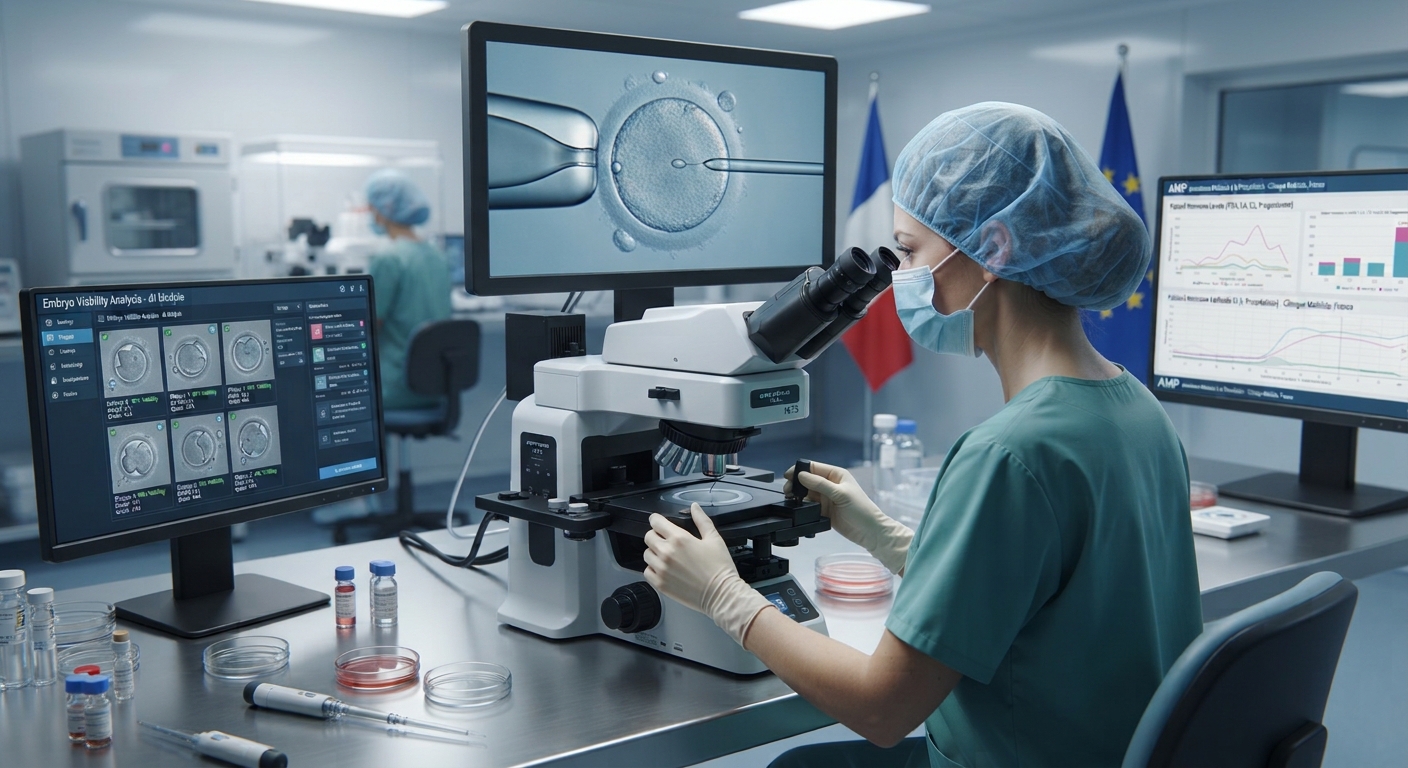
- Two European companies are developing innovative molecules to reduce chromosomal defects in eggs by up to half.
- Preliminary results show promise for boosting IVF success rates amid a noticeable rise in maternal age in France.
- French doctors and experts urge caution pending clinical trials and real-world births confirming the safety of these techniques.
While men continuously produce sperm, women face an inevitable race against time, being born with a finite reserve of reproductive cells that steadily and irreversibly diminishes. In the fifth month of gestation, a female fetus carries more than 6 million eggs, a number that drops to 1 million at birth, and then to roughly 300,000 at the onset of menstruation. Thereafter, the loss of eggs accelerates alongside a decline in their quality with age, reducing the chances of natural conception.
This biological challenge is doubly significant for families and residents in France, where the average age of motherhood continues to rise due to social and professional factors, driving many toward medically assisted reproduction (PMA). As part of scientific efforts to halt this deterioration, two European companies competed at the American Society for Reproductive Medicine (ASRM) congress to present unprecedented promises aimed at "rejuvenating" oocytes and reversing the mechanisms behind their chromosomal damage.
A Laboratory Race to Repair Chromosomal Defects
The roots of this advance trace back to research conducted by a team at the Max Planck Institute in Göttingen, led by German biochemist Melina Schuh. Studies demonstrated that a significant portion of eggs loses genetic coherence; instead of carrying precisely 23 chromosomes to pair with their male counterparts, numerical abnormalities arise, rendering the embryo nonviable. A 2014 study published in the journal Fertility and Sterility revealed that more than half of women aged 44 had no chromosomally normal embryos, compared to over 94% among women under the age of 37, which also explains why more than 25% of in vitro fertilization (IVF) cycles fail in their earliest days.
Researchers discovered that the chromosome-binding glue, known as "cohesin," degrades over the years due to a deficiency in a protective protein called "Shugoshin 1." Based on these findings, Melina Schuh founded Ovo Labs in January 2025, which developed a product named "EmbryoProtect 1" to be injected directly into the oocyte without subjecting the woman to systemic, grueling drug regimens. The compound successfully halved chromosomal abnormalities in mice, as well as in preliminary trials on about 100 human eggs donated by volunteers.
Competing Technologies and Guarded Hopes
In parallel, Oxford University spin-out "U-Ploïd" announced a complementary approach; instead of bolstering cohesion proteins, its molecule, named "Lyvanta," inhibits the enzymes responsible for breaking down chromosome linkages. During the ASRM congress, the company asserted that the proportion of defect-free oocytes reached 66% after treatment, compared to 36% without it, representing an increase of approximately 84% in healthy eggs. The company is currently in discussions with European and British health authorities to launch clinical trials, emphasizing that any commercial rollout will not happen for several years.
Caution Across French Medical Circles
Despite the hopes pinned on these findings reported by international media, the French medical community urges restraint and warns against excessive optimism. Dr. Samir Hamamah, a gynecologist at the Ambroise-Paré-Hartmann hospital and co-chair of the national steering committee for the "Fertility Plan"—whose recommendations are due to be delivered to Health Minister Stéphanie Rist—stressed that "the road remains long." He pointed out that chromosomal abnormalities are sometimes linked to male factors in 5% to 8% of cases, recalling that many announcements in the field of assisted reproduction have failed to translate into practical success.
For his part, geneticist and fertility expert Jean-Pierre Siffroi warned that fully confirming the efficacy and safety of these techniques requires extensive studies and meticulous follow-up of real babies born following these treatments, to ensure there are no long-term side effects on children's health.
Source: L’Express



Comments (0)
You must log in to comment on articles.
Log in Sign upBe the first to comment on this article.