

La Roche-sur-Yon: Former Michelin Factory Site Transformed into a Pioneering Model of the Symbiotic Economy
The "Atinéa" project in La Roche-sur-Yon is turning the former 20-hectare Michelin factory site into a model of the symbiotic economy, bringing together sustainable industry, clean transport, and local heritage.

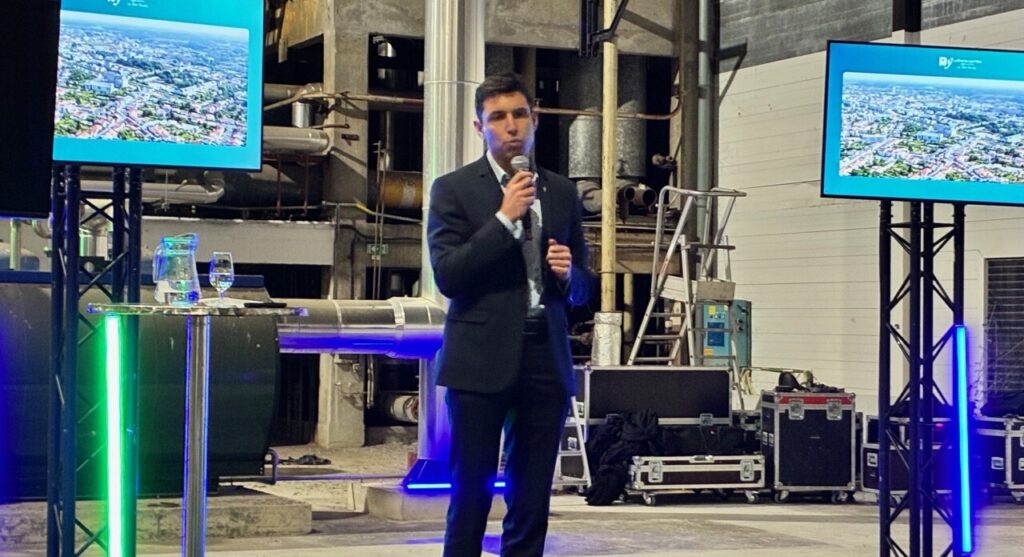
- Theorist Isabelle Delannoy hosted to introduce symbiotic economy principles across the 20-hectare 'Atinéa' site.
- The hub accommodates clean transportation pioneers including RATP Dev and Dubreuil, alongside a Sydev multi-energy station.
- Preservation of the historic working-class legacy of the Michelin factory, retaining its iconic red-and-white chimney as a symbol of industrial transition.
In a step aimed at reshaping sustainable industry, the "Atinéa" project hosted researcher and theorist Isabelle Delannoy, a specialist in the symbiotic economy (économie symbiotique), on November 18 to lay the groundwork for regenerating natural resources and living ecosystems at the core of future industrial strategies in the French city of La Roche-sur-Yon.
Revitalizing a Massive Industrial Site
The "Atinéa" project is spearheaded by a consortium comprising Banque des Territoires, the Michelin Group, and the semi-public company Oryon. This partnership seeks to provide a new horizon for the 20-hectare disused industrial brownfield along the motorway toward Nantes, a site inherited from the historic Michelin manufacturing plant.
The site currently houses three major players: the Dubreuil Group, which focuses on retrofitting commercial vehicles to run on alternative energy; RATP Dev, which provides training for mechanics on hydrogen bus maintenance; and the Sydev energy syndicate, which operates a multi-energy refueling station.
Economic Cooperation and Ecological Transition
The local government of the La Roche-sur-Yon urban agglomeration aims to push this project even further. Delphine Berthelot, Vice-President of the agglomeration in charge of economic development, posed a pivotal question to investors: "How do we produce differently, generate wealth without depleting resources, and make the ecological transition a genuine driver of economic development?"
For his part, Romain Bossis, President of the La Roche-sur-Yon agglomeration, emphasized that the symbiotic economy model offers the fitting response to these challenges, noting that conserving natural resources, curbing carbon footprints, implementing circular economy mechanisms, and enhancing social ties are all vital pathways to reinventing production and labor in light of tangible climate shifts.
A Future Rooted in Working-Class Memory
During her presentation, Isabelle Delannoy explained that industry can transform into a revitalizing force for its regional environment rather than an extractive one—an ambition the "Atinéa" site aims to materialize on the ground as a benchmark for this collaborative approach.
The President of the La Roche-sur-Yon agglomeration underlined that building the future does not imply erasing the past, paying tribute to the hundreds of workers and families whose livelihoods were tied to the Michelin plant for decades. Accordingly, it was decided to preserve the landmark red-and-white chimney as a visual and symbolic beacon honoring working-class memory and bridging it with the new industrial vision.
Source: Actu
Comments (0)
You must log in to comment on articles.
Log in Sign upBe the first to comment on this article.