

Physics Study Settles the Debate: Time Travel Is Possible Only Toward the Future, Returning to the Past Is Impossible
A recent physics study puts an end to science fiction speculations, proving that time travel is strictly a one-way ticket to the future, as the fundamental geometry of spacetime makes returning to the past impossible.

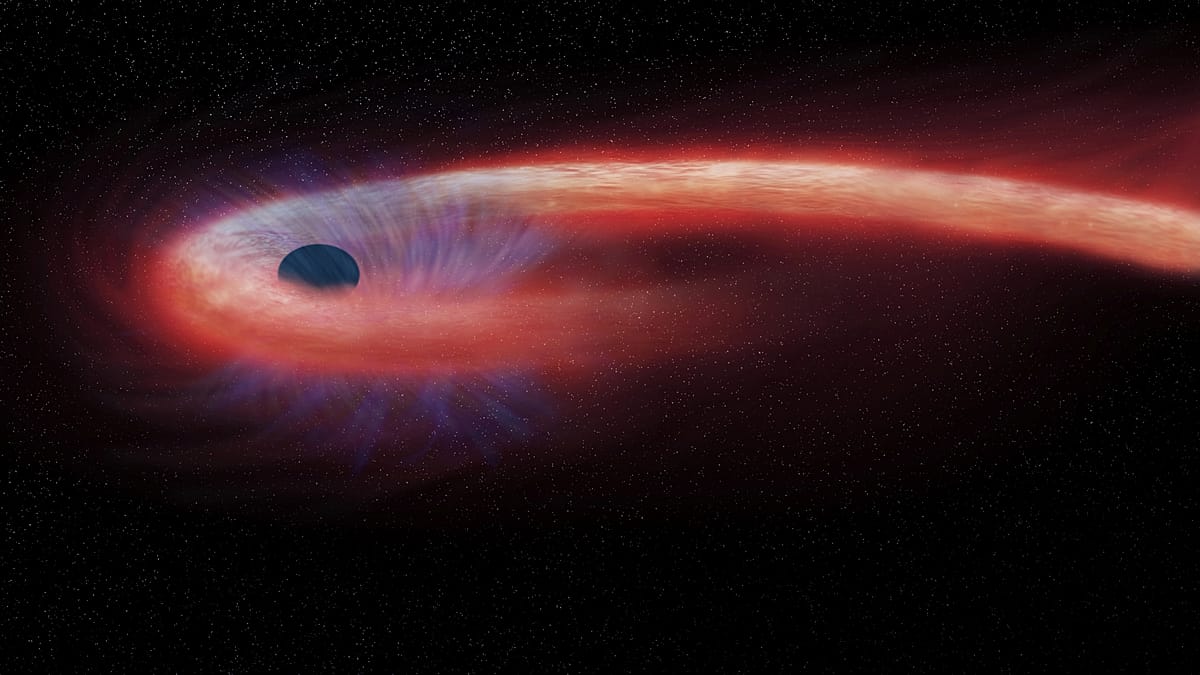
- A physics researcher from Jinan University demonstrates that the geometry of the universe prevents returning to the past, forcing forward progression only.
- Two rare theoretical loopholes to circumvent the rule involve rotating black holes and spacetime topology.
- Traveling to the future remains an established scientific fact grounded in Einstein's theories and European Space Agency observations.
Humanity has long entertained imaginative questions about what could be done with a time machine: would we leap forward to the year 3000 to discover the fate of planet Earth, or travel back to alter past events as cinema and Hollywood have portrayed? However, a recent physics study has put an end to these fantasies, confirming that time travel tickets are strictly one-way: toward the future.
A One-Way Cosmic Ladder
Through rigorous mathematical proof, researcher Hongsheng Zhang, an academic at Jinan University in China, has concluded that returning to the past is impossible across a broad class of theoretical cosmological models. The researcher relies on the fact that light cannot be directed sideways relative to a traveler's temporal direction. This means that if the fabric of "spacetime" is divided into light-like surfaces, any object moving slower than the speed of light is compelled to cross these surfaces always in the same direction—much like ascending a ladder that allows no step backward.
Two Theoretical Loopholes to Break the Rule
Scientists explain that traveling to the past requires what is known in physics as "closed timelike curves," which are paths that allow returning to the starting point and the exact same moment in time without exceeding the speed of light. According to Zhang's research, a time machine could only circumvent this geometric barrier through two specific pathways:
The first pathway involves the phenomenon of "twisting," where rays of light wrap around each other, as occurs near the centers of rotating black holes. Physicist Brandon Carter demonstrated as early as 1968 that rotating mass drags spacetime along with it to the extent that forward movement bends into a circle, returning the traveler to their point of departure. The second pathway relates to the "topology" of the universe and its geometric shape, such as wormholes where dimensions fold to turn top into bottom—a loophole that Zhang considers unlikely to occur naturally without deliberate engineering and technological intervention.
The Confirmed Destination: Tomorrow
In contrast, the study confirms that traveling into the future remains a proven scientific reality based on Albert Einstein's relativity. Moving at extremely high speeds or existing within a strong gravitational field inevitably slows down clocks relative to others. Data from the European Space Agency corroborates this principle: astronauts returning from a six-month stay aboard the International Space Station are roughly five milliseconds younger than those who remained on Earth. Thus, the ticket to tomorrow remains valid, while the doors to the past are permanently closed.
Source: Euronews (فرنسي)


Comments (0)
You must log in to comment on articles.
Log in Sign upBe the first to comment on this article.