

Georgia: Mass Demonstrations in Tbilisi Demand EU Accession and Reject Russian Influence
More than 10,000 protesters gathered in the Georgian capital, Tbilisi, denouncing the ruling party's policies, marking two years since the suspension of EU integration talks, and protesting against Russian influence.

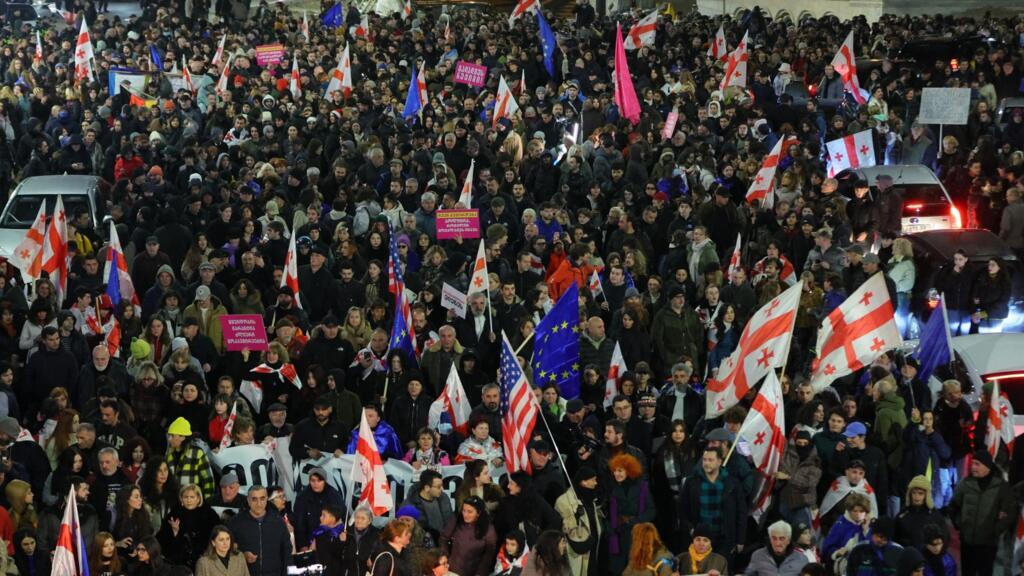
- More than 10,000 people took part in a march in Tbilisi called by opposition parties and civil movements against the 'Georgian Dream' party.
- Protesters marked the two-year anniversary of the government freezing EU accession negotiations on November 28.
- Widespread condemnation of repression, heavy fines, corruption, and growing rapprochement with Russia, amid demands for new elections.
More than 10,000 people gathered in the Georgian capital, Tbilisi, responding to calls from opposition parties and civil movements to denounce the policies of the ruling 'Georgian Dream' party—a notable turnout in a country of less than four million people—marking two years since the freezing of the EU integration path and protesting what they describe as an authoritarian drift and subservience to Russia.
Commitment to the European Dream and Rejection of Dependency
Crowds waved Georgian, Ukrainian, and European Union flags, affirming their explicit desire for political change. Nino, 21, draped in the European flag, expressed her hope for the formation of a new government that brings the country closer to Europe and allows Georgians to live within the European space within five to ten years.
November 28 marks a significant milestone in the country's political memory; on this day two years ago, the government announced the suspension of EU accession negotiations, a decision widely rejected by the pro-Western majority, some of whom have continued daily protests despite arbitrary arrests and hefty fines.
Defying the 'Intimidation Strategy' and Affirming Democracy
Protesters arriving from eastern Georgia, including Temo, affirmed that the government relies on a strategy aimed at instilling fear and exhaustion through fines and threats, stressing that surrender means a return to Russian hegemony. In turn, protester Nata explained that demands center on living in a free and democratic Georgia, stating that the current government's policies are pushing the country in a direction completely contrary to European democratic values.
In some locations, the gatherings exceeded the organizational capacity of police forces amid an enthusiastic atmosphere where participants voiced their frustration over corruption and the high cost of living, renewing their call for fresh elections and injecting new momentum into the popular movement supporting European integration.
Source: RFI
Comments (0)
You must log in to comment on articles.
Log in Sign upBe the first to comment on this article.