

EU Expands Ukraine Peace Negotiation Team with France, Rules Out Single Envoy
European Union leaders in Dublin agreed to form an expanded joint negotiating team including France, Germany, the UK, Italy, and Poland to represent Europe in Ukraine peace talks, rejecting the appointment of a single envoy.

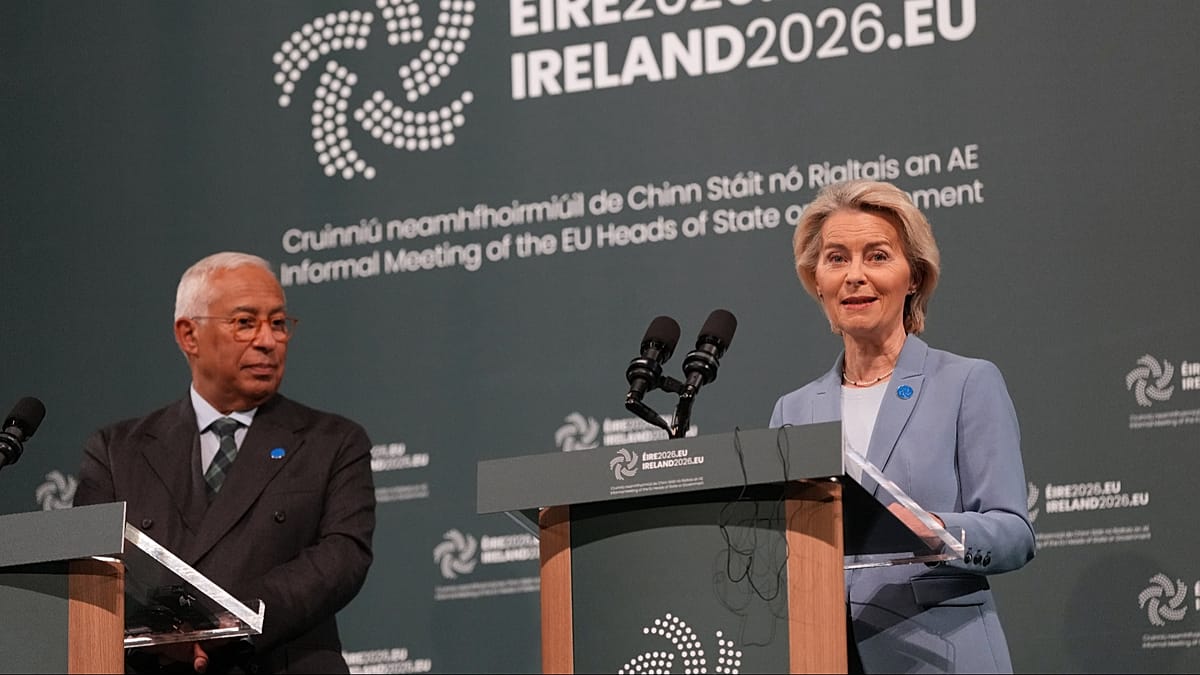
- EU leaders agree in Dublin to represent Europe through a team comprising France, Germany, the UK, Italy, and Poland, alongside NATO and EU institutions.
- A proposal to appoint a single diplomatic envoy was rejected, sidelining foreign policy chief Kaja Kallas from leading the talks.
- Washington-sponsored diplomatic efforts await Moscow's consent to sit at a direct negotiating table with the European delegation.
EU leaders decided, during an informal summit held in the Irish capital, Dublin, to establish a joint negotiating team to represent the European continent in the peace talks aimed at ending the war in Ukraine. The team includes France, Germany, Italy, and Poland, in addition to the United Kingdom, alongside representatives from the European Council, the European Commission, and the North Atlantic Treaty Organization (NATO).
Expanded Representation and Rejection of a Single Envoy
European leaders resolved a prolonged debate over appointing a unified special envoy—an option favored by Ukraine, the United States, and Russia—opting instead to expand the existing format known as the 'E3' (France, Germany, and the UK) to include both Italy and Poland. Warsaw's inclusion followed explicit warnings against Western European nations making decisions on behalf of the bloc's eastern flank.
European Council President António Costa confirmed that the accredited European negotiating team now officially consists of EU institutions and the group of five nations within a 'coalition of the willing,' expressing hope that these arrangements will yield tangible results to end the conflict.
Marginalization of Diplomat Kaja Kallas and Prerogative Dispute
The decision dealt a blow to EU foreign policy chief Kaja Kallas, who had publicly sought the role of special envoy, defending her mandate to lead the portfolio. Kallas acknowledged in her remarks that Moscow refuses to engage with her due to her firm stance toward Russia.
In contrast, both António Costa and European Commission President Ursula von der Leyen refused to back Kallas's bid, maintaining that EU treaties are clear regarding the presidents representing the bloc on high-level foreign and security matters. Meanwhile, German Chancellor Friedrich Merz affirmed the efficacy of the expanded format, noting there was no need to open an institutional debate on naming a single envoy at present.
Anticipating the Russian Stance and US Mediation
This European move comes in step with mediation efforts led by the United States, following preliminary rounds held in several cities including Miami, Oslo, Brussels, and Abu Dhabi with Italy's participation, with Poland set to join the upcoming round.
Attention now turns to whether Moscow is prepared to accept direct negotiations with this unified European team, following talks held in Moscow by US envoys Steve Witkoff and Jared Kushner with President Vladimir Putin to urge Russia to sit face-to-face with the Europeans—a step about which the Kremlin remains cautious to confirm.
Source: Euronews (فرنسي)
Comments (0)
You must log in to comment on articles.
Log in Sign upBe the first to comment on this article.