

2027 French Presidential Candidates Face the China Test: A Sharp Contrast Between Diplomatic Unfamiliarity and Strategic Engagement
As the 2027 French presidential election draws near, foreign policy toward China emerges as a critical test, revealing deep divides among contenders from lack of firsthand experience to extensive engagement.

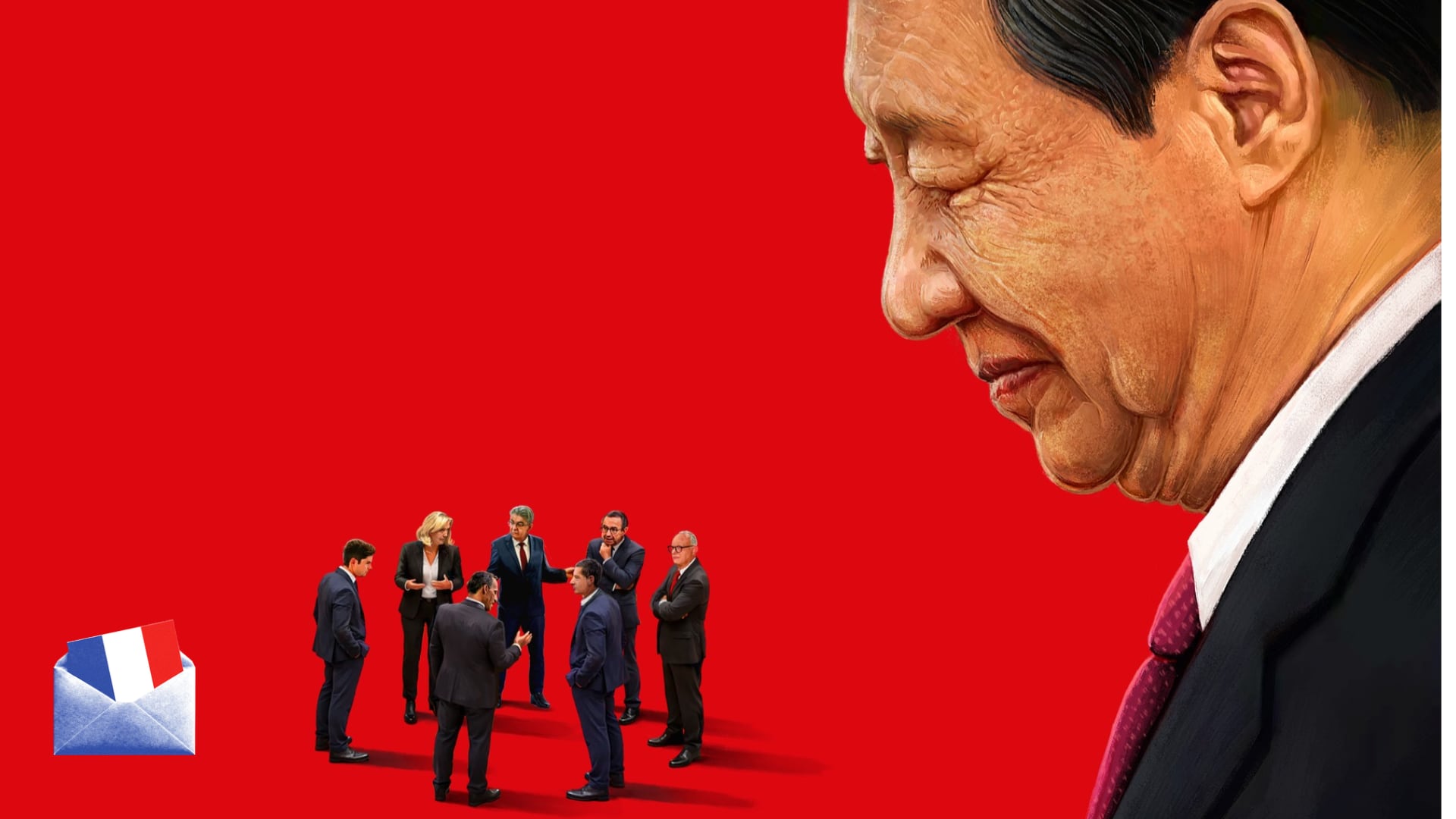
- French political figures, notably former Prime Minister Jean-Pierre Raffarin, warn that failing to visit and understand China means lagging behind in comprehending the modern world.
- A notable contrast marks the right and center: Marine Le Pen rules out visiting Beijing for domestic electoral reasons, while Édouard Philippe possesses extensive experience and ties there.
- The French left is deeply divided between Jean-Luc Mélenchon's diplomatic rapprochement with China and Raphaël Glucksmann's firm rejection of Beijing's policies over the Uyghur issue.
As the 2027 French presidential election approaches, foreign policy emerges as one of the greatest tests for candidates, specifically regarding how to manage relations with the world's second-largest demographic and economic powerhouse: the People's Republic of China. At a time when Beijing has become a decisive global player engaged in a technological race impacting all markets, contenders for the Élysée Palace are divided between those unfamiliar with the country from within and those possessing extensive insight into its complexities.
A French Affliction and Strategic Distance
Former French Prime Minister Jean-Pierre Raffarin describes neglecting to travel to Beijing as a "real French disease," asserting that failing to visit China equates to not understanding today's world and lagging behind it. This assessment comes at a time when past French presidents, such as Emmanuel Macron and François Hollande, had not visited Beijing prior to entering the Élysée, as was also the case with Charles de Gaulle, Valéry Giscard d'Estaing, and Georges Pompidou—who conducted the first official visit by a French president in 1973.
Between Le Pen’s Calculations and Philippe’s Expertise
In the far-right camp, Marine Le Pen does not plan to visit China before May 2, 2027, with her team arguing that such a trip would yield no electoral benefits domestically in France. Le Pen, who met with the Chinese ambassador in Paris, emphasized in 2022 that France must maintain equal distance from Washington and Beijing, calling for frank and non-adversarial relations to avoid being dragged into an empire conflict.
In contrast, former Prime Minister Édouard Philippe is considered the most knowledgeable about Chinese reality, having visited the country almost annually between 2004 and 2017, alongside an extended four-week stay in 1997, an official visit in 2018, and another in 2025. The mayor of Le Havre, which holds a sister-city agreement with the Chinese city of Dalian, believes the center of economic and political gravity is shifting toward Asia, repeatedly warning of Beijing's accelerating technological superiority.
Digital Popularity and Economic Calculations
Elsewhere, Gabriel Attal has emerged as a notable phenomenon on Chinese social media platforms such as "RedNote," where videos highlighting his career and youth garner millions of views, despite him having visited China only once in 2018 as part of a parliamentary delegation. Attal stressed in press remarks that China's economic and technological influence, alongside European trade vulnerabilities toward it, are matters of deep concern to him.
For their part, other candidates, such as Bruno Retailleau, chose direct engagement with the Chinese ambassador in Paris to understand Beijing's long-term strategies and engineer training. Meanwhile, David Lisnard, the mayor of Cannes, formed his perspective through past tourism promotion missions that took him to Wuhan, Chengdu, and Shanghai, describing China as both an economic partner and a strategic competitor.
A Sharp Divide on the Left
The starkest contrast appears within the left. On September 23, 2026, Jean-Luc Mélenchon was prominently received at the Chinese Embassy in Paris during celebrations for the 77th anniversary of the founding of the People's Republic of China. Mélenchon defends the "One China" policy, viewing Taiwan as an integral part of it, and regards Beijing as an alternative, more reliable partner compared to the United States.
By contrast, Raphaël Glucksmann stands at the opposite pole, having been banned from entering Chinese territory between March 2021 and May 2025 over his vocal defense of the Uyghur minority. Glucksmann visited Taiwan in October 2021 leading a European parliamentary delegation, sharply criticizing appeasement toward the Chinese Communist Party and affirming that his stance targets the ruling regime rather than the Chinese people—illustrating the depth of French political polarization over international diplomacy and human rights.
Source: L’Express
Comments (0)
You must log in to comment on articles.
Log in Sign upBe the first to comment on this article.