

France: Nova Carbon Prepares to Industrially Recycle Carbon Fiber to Support the Aerospace Sector
French startup Nova Carbon is preparing to scale up the industrial recycling of carbon fiber from its base in Mérignac, deploying an innovative technology that preserves fiber length to support the aerospace, maritime, and automotive industries.

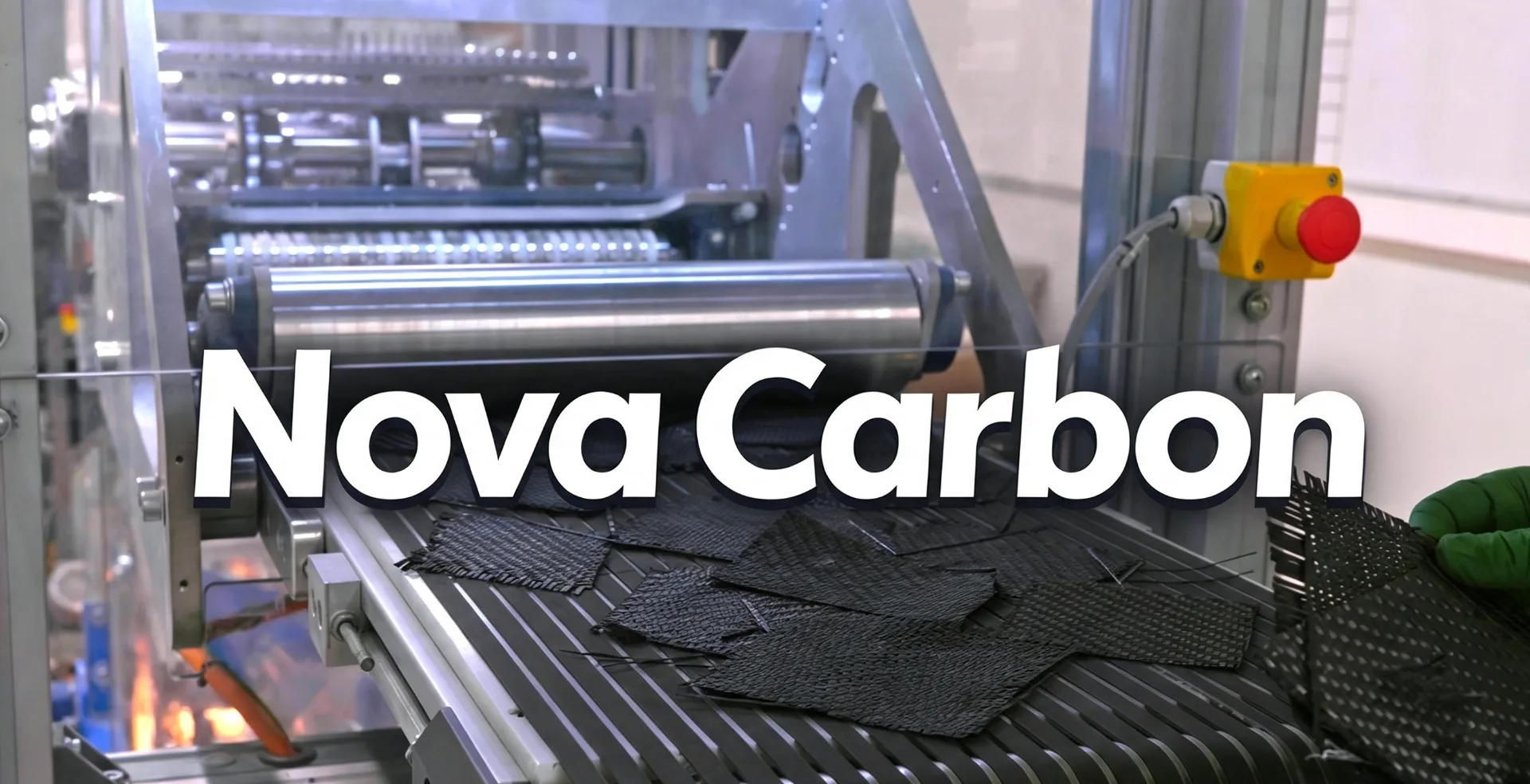
- Nova Carbon's AURORRA project was selected for the 'Première Usine' (First Plant) program supported by the 'France 2030' plan.
- The company employs a unique technology that preserves and realigns long fibers rather than grinding them, ensuring the mechanical performance of structural parts.
- Nova Carbon aims to reach an annual production capacity of approximately 200 tons by 2028 and 1,500 tons by 2030, partnering with industry leaders such as Safran and Alpine.
France continues its efforts to boost environmental and industrial innovation through investments in sustainable technologies. In this context, Nova Carbon, a startup based in Mérignac in the Gironde department, aims to bring about a qualitative shift in processing carbon fiber waste and repurposing it for high-precision sectors such as aerospace, maritime, and automotive manufacturing.
Preserving Long Fibers to Ensure Quality
The technology developed by the company is based on a precise engineering principle: fibers that are ground and fragmented lose a substantial portion of their mechanical properties compared to long, carefully aligned fibers within manufactured components. Consequently, Nova Carbon has developed a technical process based on deweaving and realigning dry fabric scraps resulting from cutting operations, converting them into intermediate materials in the form of tapes, fabrics, and ready-to-use preforms that manufacturers can integrate directly into their production lines.
The importance of this step lies in recovering a material whose primary production consumes vast amounts of energy, while avoiding turning it into short fibers that lose their value when used in the manufacturing of critical structural components.
From Academic Laboratories to an Industrial Venture
The origin of this technology traces back to advanced research conducted at the Institute of Mechanics and Engineering in Bordeaux, in partnership with the University of Bordeaux, the French National Centre for Scientific Research (CNRS), and their partners. The 'DEFI-CARBONE' program contributed to developing a semi-industrial prototype and securing patent protection, before the technology transfer accelerator 'SATT Aquitaine' stepped in to guide the project toward commercialization.
Co-founders Hugo Cartron and Vincent Gamboa led the efforts to establish the company starting in 2022, culminating in the signing of an exclusive license in 2023 to begin the actual industrialization phase of this technology, which emerged from the public scientific research ecosystem.
The AURORRA Project and Future Production Prospects
Following an initial €1.4 million funding round in June 2024 to finance a pilot production line and expand the research team, the company's project, known as 'AURORRA', is preparing to transition to large-scale production. The project received official backing through its selection under the 'Première Usine' (First Plant) program, managed by the public investment bank Bpifrance as part of the 'France 2030' plan.
The project aims to reach an annual production capacity of approximately 200 tons by 2028, with ambitions to gradually expand this capacity to 1,500 tons by 2030 at the Mérignac industrial site.
Promising Partnerships in the Gironde Industrial Hub
This development has opened avenues for collaboration with leading industrial groups, including Safran, through the valorization of production waste, as well as companies such as Epsilon Composite, Alpine, and Grand Large Yachting. Targeted applications range from composite tooling and equipment manufacturing to water sports gear requiring lightweight construction and high durability.
This project strengthens the industrial ecosystem in the Gironde department, which is also witnessing growth in the aerospace and maintenance sectors with major companies such as Sabena technics, opening new avenues for circular economy development and industrial employment in southwestern France.
Source: bougerabordeaux

Comments (0)
You must log in to comment on articles.
Log in Sign upBe the first to comment on this article.