

French Judo Champion Teddy Riner's Presidential Bid Sparks International Media Interest and Reshuffles the Race for the Élysée
Six months ahead of the French presidential election, 37-year-old judo legend Teddy Riner has officially entered the race for the Élysée Palace, drawing intense global media attention and reshaping an already polarized contest.

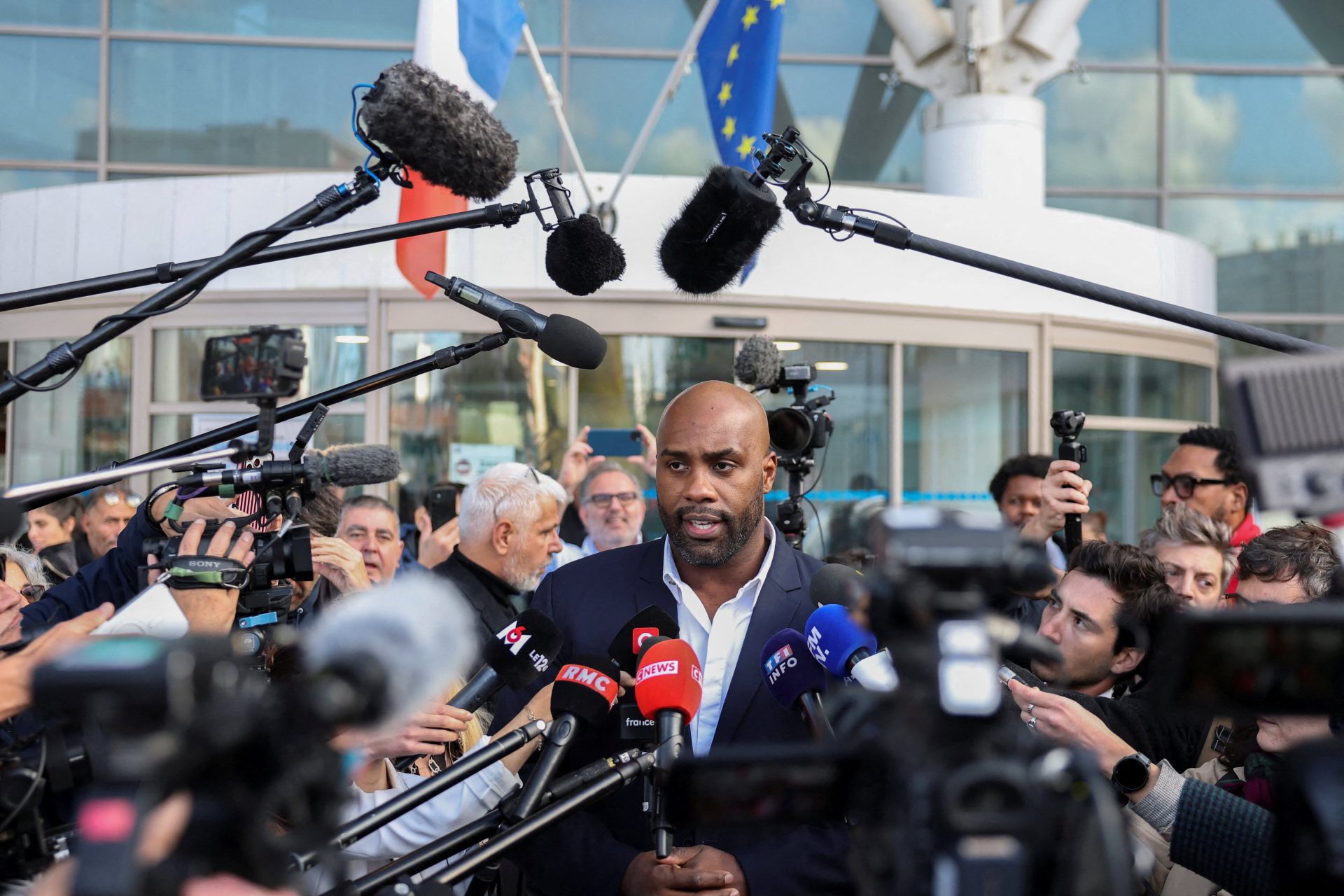
- French judo legend Teddy Riner (37) announces his candidacy for the Élysée Palace, garnering over 27 million views and sparking widespread global reaction.
- An opinion poll credits Riner with around 22% of voting intentions, showing his potential to draw support across diverse political spectra.
- International analyses view his bid as an attempt to salvage the centrist camp and block a potential far-right ascent to power.
Six months ahead of the French presidential election, marked by sharp polarization and a multitude of candidacies, a sudden event has captured the attention of observers and the international press: French judo champion Teddy Riner, 37, officially announced his entry into the race for the Élysée Palace.
The announcement came via a short video clip posted by Riner on social media platforms, which garnered around 27 million views in a short period. The Belgian daily Le Soir described the move as having reshuffled the cards of a contest that had seemed virtually settled as a final-round showdown between the far-right and the radical left. Meanwhile, the Spanish newspaper El País noted that while the bid initially appeared to be one of the paradoxes of the pre-campaign period, Riner is approaching it with utmost seriousness, swiftly gaining unexpected backing from political figures, as well as the support of President Emmanuel Macron himself.
A Discourse Focused on State Authority and the Value of Work
Although the multi-time Olympic gold medalist emphasized in his video that he is "neither from the right nor from the left," Le Soir considered that his focus on "restoring state authority" and defending a "France of merit and work" practically places him on the political right. The paper also pointed out that the early support he received from Macron's camp prompted some analysts to question whether his candidacy was driven directly by the Élysée Palace.
El País examined Riner’s style, suggesting he understands the mechanics of public appeal by addressing social divisions and positioning himself as an agent of security and stability. With a touch of political irony, the paper referenced his formidable physical stature (2.04 meters and 145 kilograms), asking: "Who better than a martial arts expert to protect the nation in times of turmoil?"
From the Judo Mat to the Political Arena
Transitioning from the sporting world to politics is not unprecedented. The Swiss newspaper Le Temps recalled notable figures who made the leap from combat sports to the political arena, including David Douillet, a former French MP and Minister of Sports under Nicolas Sarkozy. Commenting on this path, Swiss judoka and politician Sergei Aschwanden explained that the discipline equips its practitioners to face challenges and engage in fierce battles within a strict ethical framework. He emphasized that "a good judoka, knowing how to fall, possesses the ability to rise again, which is essential in political practice."
An Attempt to Rescue the Center Amid Polarization
Observers believe the attention surrounding Riner's candidacy fundamentally reflects a crisis within the ruling establishment. Speaking to Le Soir, political analyst Blanche Leridon of the Institut Montaigne explained that there is a state of confusion within both the right and the center, as the search continues for a "savior" to rescue the camp from its precarious situation.
In terms of polling figures, the first survey conducted by Ifop revealed that his electoral potential currently hovers around 22%. Although a gap remains between this figure and the far-right's projected support of roughly 35%, the outcome demonstrates his ability to cut into the voter bases of the center, the right, the Socialist Party, and even France Unbowed (La France Insoumise).
In the same vein, The New York Times highlighted Riner’s appeal among young voters who typically lean toward radical-left leader Jean-Luc Mélenchon, asserting that none of the current contenders embody the outsider, non-traditional candidate persona quite like Riner.
Second-Round Scenarios
Despite the current momentum, observers agree that Riner’s path to power remains considerably steeper than that of Emmanuel Macron in 2017, who, though new to elections at the time, was an alumnus of the École Nationale d'Administration (ENA), the training ground for the state elite. Nonetheless, international newspapers view this political development as a reflection of deep anxiety over recent polls. A recent survey published by Le Parisien and cited by El País projected that the second round would, under all scenarios, be confined to Marine Le Pen (34% to 36%) and Jean-Luc Mélenchon (18% to 19%), making the emergence of a novel figure an effort to disrupt the status quo and prevent the far-right from taking power.
Source: L’Express
Comments (0)
You must log in to comment on articles.
Log in Sign upBe the first to comment on this article.